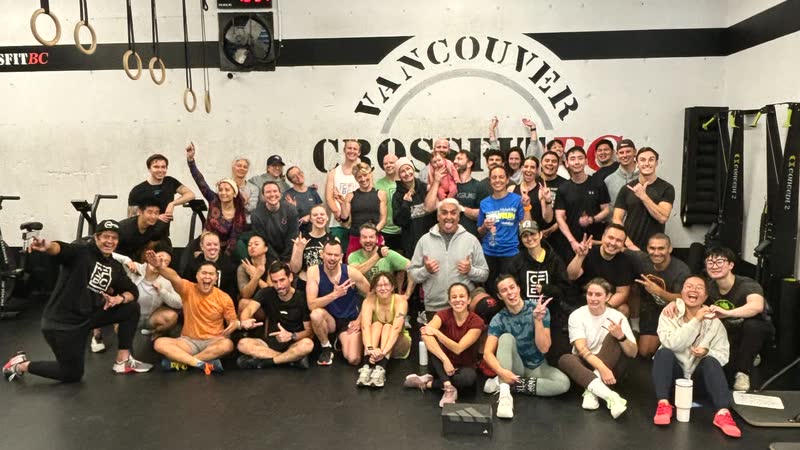
How to Train for Your First HYROX Race
Everything a first-timer needs, from your opening 1 km run to race day: the eight stations, the running build, pacing, and the mistakes that cost beginners time. Written by the CrossFit BC coaching team in Olympic Village, where we have coached this city since 2008.
In this guide
Section 01
What is HYROX?
HYROX is a global fitness race designed for everyday athletes. Every event is identical: you run 1 kilometre, complete one functional workout station, then run another kilometre, hit the next station, and repeat until you have finished eight runs and eight stations. Same movements, same order, same standards, whether you race in Vancouver, Berlin, or Las Vegas.
That consistency is the whole appeal. Unlike an obstacle race full of surprises, HYROX is a known quantity. You can train the exact movements you will face, practise the exact transitions, and walk to the start line knowing precisely what is coming. It rewards preparation, pacing, and grit more than raw talent, which is why so many people fall in love with their first one.
The movements are simple on paper: running, a SkiErg, a sled push, a sled pull, burpee broad jumps, rowing, farmers carries, sandbag lunges, and wall balls. The challenge is doing them back to back, tired, with your heart rate pinned. That is the puzzle HYROX training solves.
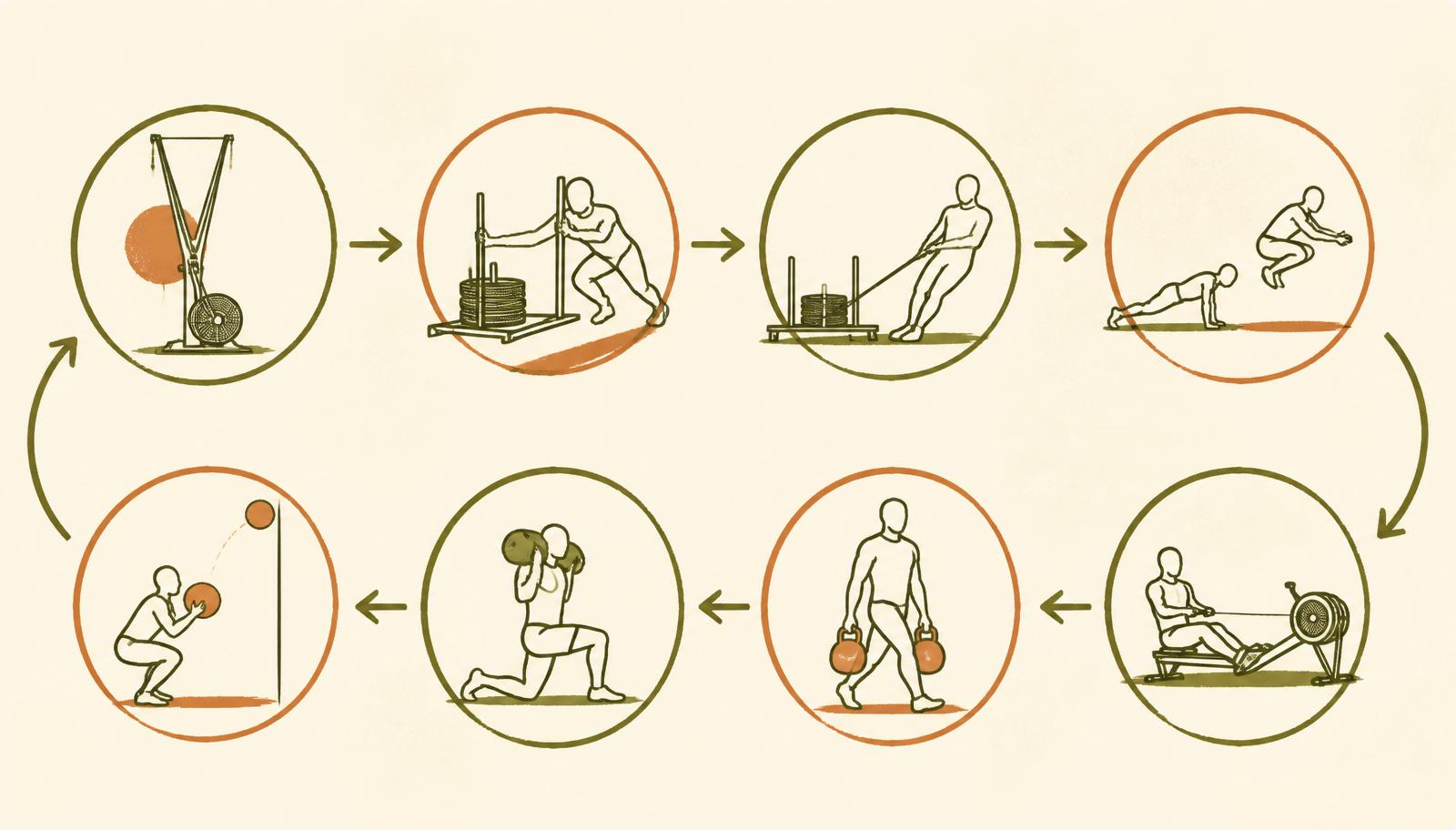
Same 8 stations, every race
Eight 1 km runs paired with eight functional stations, always in the same order. Once you know the map, you can train the route.
Section 02
Training for HYROX in Vancouver
Vancouver is a near-perfect city to train for HYROX. The seawall, the bridges, and the neighbourhood loops give you endless flat and rolling running routes. The community is deep and growing, and the interest in hybrid racing has exploded over the last two years.
At CrossFit BC in Olympic Village, we have been coaching this city since 2008, and HYROX prep has become one of the most popular things we do. We run dedicated HYROX-format classes through the week, plus our 90-minute Saturday SIM-ilar sessions that rehearse the full race feel. You get coached running, real sled tracks, and every station under one roof, with coaches who race themselves.
Section 03
The HYROX race format
Here is the full sequence, in order. Every race runs the same way, with a 1 km run before each station.
| Run | Station | |
|---|---|---|
| Run 1 | 1 km | 1000 m SkiErg |
| Run 2 | 1 km | 50 m sled push |
| Run 3 | 1 km | 50 m sled pull |
| Run 4 | 1 km | 80 m burpee broad jumps |
| Run 5 | 1 km | 1000 m row |
| Run 6 | 1 km | 200 m farmers carry |
| Run 7 | 1 km | 100 m sandbag lunges |
| Run 8 | 1 km | 100 wall balls |
Notice the order. The race opens with the SkiErg and closes with 100 wall balls, the station everyone respects. Training is partly about getting strong at each piece and partly about learning to manage your effort so you still have legs for those final wall balls.
Section 04
Where to start as a beginner
The hardest part of HYROX is signing up for the first session. After that, the path is simple. You do not need to be fit, fast, or experienced. You need to start.
Your first move, based on where you are
- 01
Brand new to fitness or coming back after a long break?
Start with our 3 free classes and tell the coach you are HYROX-curious. We will scale every movement and build your base before you touch a race plan.
- 02
Already train but new to HYROX?
Jump into a HYROX-format class and a Saturday SIM-ilar session. You will learn the stations and transitions fast, and find out your real starting point.
- 03
Have a race date on the calendar?
Talk to a coach about a focused 8 to 12 week block. We will dial in your running, station pacing, and a taper so you arrive ready.
- 04
Want one-on-one attention?
Personal training pairs you with a coach who builds a HYROX plan around your schedule, your weak stations, and your goal time.
Whichever row fits you, the entry point is the same: get in the room. The fastest way to do that is to try 3 classes free, no card on file.

Free Resource
Want a tool that makes this easier?
Our free The Vancouver HYROX Training Guide is the same tool our coaching team uses with every new member.
Section 05
The eight stations, explained
Each station is a skill you can train. Here is what to know about the big ones, and where to go deeper.
SkiErg (1000 m). The race opener. Fresh legs make this feel easy, so the trap is going too hard. Pull tall, drive with the hips, and pace it so you can run after.
Sled push and pull (50 m each). The two stations that humble strong people. Low body position, short choppy steps on the push, hand-over-hand commitment on the pull. Our sled push and pull guide breaks down the technique.
Burpee broad jumps (80 m). A grind, not a sprint. Find a rhythm, keep the jumps short and repeatable, and breathe.
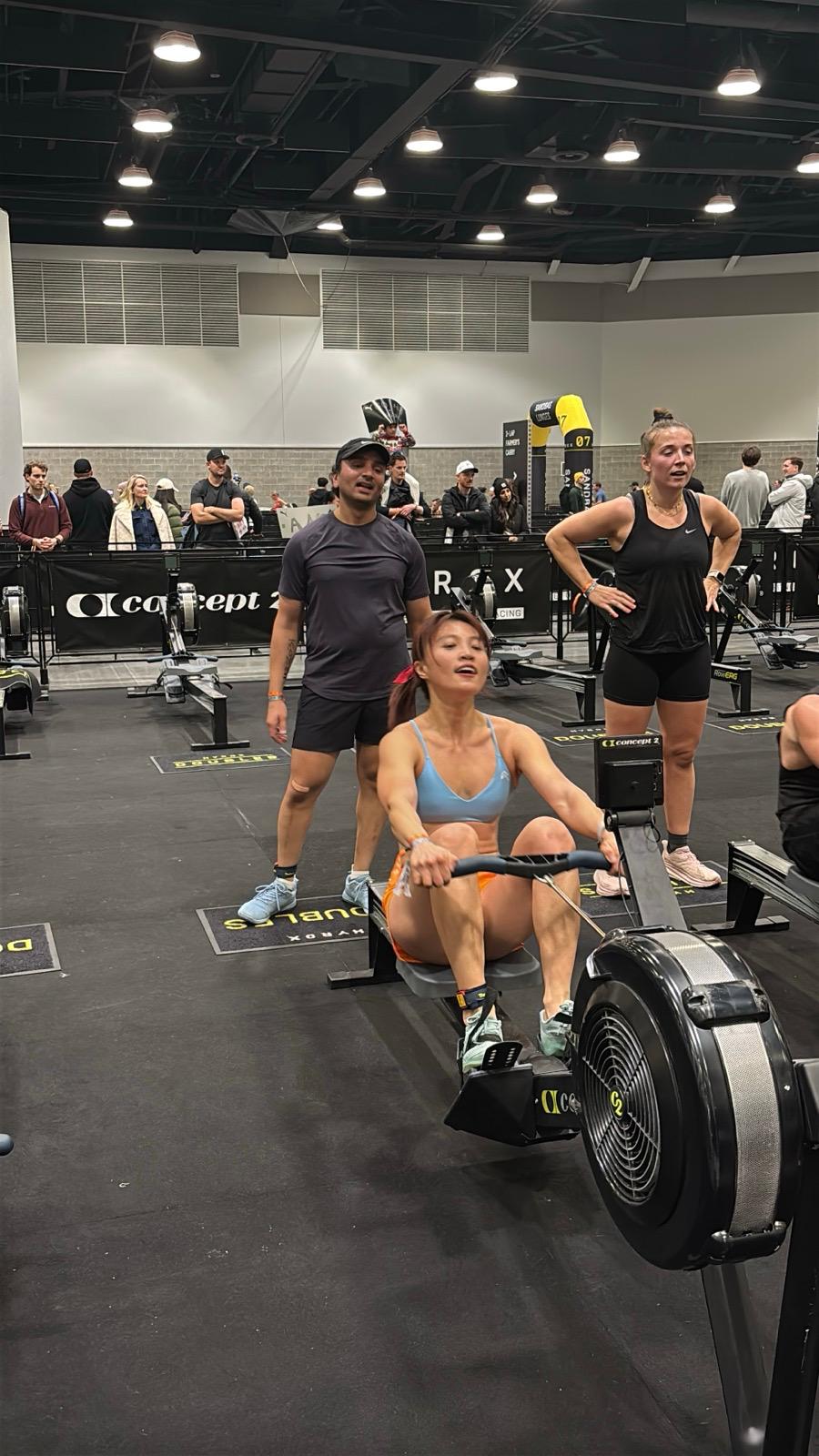
Row (1000 m). Mid-race, on tired legs. Damper and drag factor matter here. See our Concept2 RowErg guide for pacing.
Farmers carry (200 m) and sandbag lunges (100 m). Grip, posture, and patience. These reward people who keep moving instead of stopping to rest.
Wall balls (100 reps). The finish line gauntlet. Consistent depth, full extension, and a breathing pattern you can hold. Our HYROX wall balls guide covers standards and survival.
Section 06
A beginner-to-race-day plan
You do not need a complicated program. You need consistency across three pillars: run, build strength, and rehearse the race. Here is a simple weekly shape most of our HYROX athletes follow.
| Focus | What it looks like | |
|---|---|---|
| 2 to 3 mixed-fitness days | Class-style training | CrossFit-style sessions that build your engine and full-body strength |
| 1 to 2 running days | Easy + intervals | One easy aerobic run, one set of 1 km repeats to rehearse race pace |
| 1 station / SIM day | Saturday SIM-ilar | Rehearse stations and transitions in race order, at race feel |
| Recovery | Mobility + sleep | At least one full rest day; protect sleep in race-prep weeks |
The magic ingredient is the SIM-ilar session. Running 1 km repeats in your own training is useful, but rehearsing eight runs paired with stations in race order teaches your body the one thing nothing else can: how to keep moving when your legs are already cooked. That is the skill HYROX actually tests.
Running is the spine. If the run holds, the whole race holds together.
Section 07
Training the running
Running is the spine of HYROX. Eight kilometres across the race, always on fatigued legs after a station. Athletes who can run steady tend to have the best day, even if their station numbers are average.
You do not need to become a marathoner. Two running touches a week is plenty for most first-timers: one relaxed conversational run to build aerobic base, and one session of 1 km repeats at the pace you want to hold on race day. Vancouver makes this easy, the seawall and the neighbourhood loops around Olympic Village are right outside the door.
The mistake to avoid is running every interval flat out. HYROX running is about controlled, repeatable pace, not a single fast kilometre. Learn the pace you can hit eight times, tired, and you have solved most of the race.
Section 08
Race-day strategy
Three ideas carry most first-timers to a strong finish:
Start slower than feels right. The adrenaline of the start line will tempt you to fly out on the first run and hammer the SkiErg. Resist. The race is long, and the cost of an early blow-up is paid with interest at the wall balls.
Break the stations on purpose, not in panic. Decide your wall ball sets before you arrive (say, 20s or 25s with short breaks) rather than going until failure and stalling. Planned breaks are faster than forced ones.
Keep moving. A slow jog beats a walk, and a walk beats standing still. Forward is forward. The clock rewards momentum more than heroics.
Section 09
Common mistakes (and the fixes)
| Mistake | The fix | |
|---|---|---|
| Going out too hot | Blow up by the row | Start at a pace you could hold a conversation through run one |
| Ignoring the running | 8 km feels brutal | Two running touches a week, one easy, one at race pace |
| Never rehearsing the format | Transitions cost minutes | Train SIM-ilar sessions in race order |
| Maxing the sled in training | Trash legs for the run | Practise sled at race-realistic loads and pace |
| No wall ball plan | Stall at the finish | Pre-decide your sets and rest |
| Training alone | Motivation fades | Train with coaches and a room that pushes you |
Section 10
HYROX for North Shore athletes
Plenty of the athletes on our HYROX floor live in North and West Vancouver. The North Shore is a fitness-rich part of the Lower Mainland, but dedicated HYROX-format coaching is still thin on the ground up there, so a lot of hybrid racers make the short trip across the water to train the full format properly.
The commute is easier than it sounds. From most of the North Shore it is roughly 15 to 25 minutes to Olympic Village, whether you drive over the Lions Gate or Second Narrows bridge, or take the SeaBus from Lonsdale Quay to Waterfront and hop two SkyTrain stops to Main Street-Science World. Early classes beat the bridge traffic, and evening SIM-ilar sessions are worth planning your day around.
What you get for the trip is depth. At the HYROX gym in Vancouver you train dedicated HYROX-format classes through the week plus our 90-minute Saturday SIM-ilar race-prep sessions, with real sled tracks, every station, and coaches who race themselves. If you have been piecing HYROX prep together from general classes on the North Shore, rehearsing the full race in order is the upgrade that moves your time.
Section 11
Train for HYROX at CrossFit BC
If you want the shortest path from curious to race-ready, train where the format is coached every week. At CrossFit BC in Olympic Village, our HYROX-format classes, Saturday SIM-ilar sessions, and coaching team cover running, sleds, wall balls, and the full circuit, with scaling for every level.
Not sure which entry point fits? You can start here to compare programs, see membership options, or drop in if you are visiting Vancouver. The simplest place to begin is your 3 free classes, where a coach will get you moving and answer every HYROX question you have.
People also ask
FAQ
14 questions
Where can I train for HYROX in Vancouver?
Want a coach to walk you through it on the floor?
Try 3 Classes FreeDo I need to be fit before I start HYROX training?
How long does it take to train for a HYROX race?
What is the difference between HYROX and CrossFit?
Can I do HYROX as a beginner?
Should I race HYROX solo, doubles, or relay?
How much running is in a HYROX race?
What should I do first to try HYROX in Vancouver?
Where can I train for HYROX on the North Shore?
Do CrossFit BC members get early access to HYROX tickets?
What should I eat on the morning of my first HYROX race?
How long should I rest after my first HYROX race?
When and where is HYROX Vancouver 2026?
Bringing friends or family to cheer?
Read the spectator guideHow many HYROX classes does CrossFit BC run?
Want a coach to walk you through it on the floor?
Try 3 Classes FreeTrain with us in Vancouver
Stop guessing. Get coached.
At CrossFit BC in Olympic Village, we coach rowing, skiing, lifting and hybrid conditioning inside every class, every week. Pick the entry point that fits where you are right now.
Continue learning
More from the equipment guide series
Concept2 RowErg: Damper, Drag Factor & Technique
The damper isn't the difficulty knob. How to set it right for HYROX, CrossFit, and general fitness, plus the drag factor rule most people miss.
Concept2 SkiErg: Damper, Technique & HYROX Strategy
How to set the SkiErg damper, pace the HYROX ski pieces, and stop blowing up your lats in the first 200 meters.
HYROX Wall Balls: Standards, Strategy & Survival
100 wall balls at the end of a HYROX race break athletes. Targets, mechanics, breathing, and rep schemes that hold up under fatigue.
Sled Push & Sled Pull: A Complete Coaching Guide
How to set up, brace, breathe, and pace sled push and sled pull for HYROX, hybrid training, and unilateral strength carryover.
Calories vs Meters: How CrossFit Machines Actually Score
Why 20 cals on the rower, ski, bike, and Echo are nothing alike. The math, the strategy, and the pacing rules that change everything.
HYROX Race Pacing: Don't Win the First 20, Lose the Last 20
The pacing model used by CFBC coaches. Negative splits, station-by-station targets, and how to stop blowing up in the back half.
Farmer's Carry Guide for HYROX
Grip, posture, turns, breathing, and how not to blow up your forearms before the wall balls.
Sandbag Lunges Guide for HYROX
Rack position, stride length, breathing, and race pacing for the station that ends most athletes' day.
Burpee Broad Jump Guide for HYROX
Efficiency, step-up vs jump-up, breathing, and the race-day strategy that keeps your heart rate manageable.
HYROX Compete vs Pro vs Doubles Explained
Categories, weights, qualifying times, and which division to pick for your first race or your next PR.
Concept2 BikeErg: Damper, Cadence & Watts
Damper, cadence, watts, and pacing for CrossFit conditioning and endurance work on the most under-coached erg in the room.
Echo Bike & Assault Bike: Survival Guide
How to pace calories, run sprint intervals, breathe through the burn, and not blow up on the bike that everyone hates.
Treadmill vs Outside Running for HYROX
How to train running for HYROX without overcooking volume. When to use the treadmill, when to hit the seawall.
Monitor 101: Watts, Pace, Stroke Rate & Split
The numbers on the screen, what they mean, and which one to actually watch. The Rosetta Stone for every erg in the gym.
The Concept2 2K Test: Pacing, Mental Model & PR Plan
How to prep for the 2K test, pace the four splits, and break the wall at the 1,000-meter mark.
Kettlebell Swing Guide
Russian vs American swings, hip hinge mechanics, breathing rhythm, and the safety cues that protect your back.
Dumbbell Training for CrossFit
DB snatches, cleans, lunges, thrusters, and the scaling decisions that keep you in the workout instead of watching the clock.
Barbell Beginner Guide
Squats, deadlifts, presses, and Olympic lifts. How to approach the barbell safely in your first six months of CrossFit.
Pull-Up Bar Guide
Strict pull-ups, kipping, toes-to-bar, scaling progressions, and how to take care of your grip.
Gymnastics Rings Guide
Ring rows, dips, muscle-up progressions, and the shoulder control work that prevents the injuries everyone gets eventually.
Jump Rope & Double-Unders Guide
Singles, double-unders, rope sizing, rhythm cues, and how to actually learn DUs in under a month.
Medicine Ball Guide
Wall balls, cleans, slams, rotational work, and how to use the med ball for everything other than the standard wall-ball shot.
Box Jump Guide
Step-ups, rebounding, landing mechanics, and the injury-prevention cues that should be on every box in the gym.
How to Pace a CrossFit Workout
When to send it, when to stay smooth, and when to break reps. A pacing framework for every time domain.
How Scaling Works in CrossFit (Beginner's Guide)
Scaling is a coaching skill, not a downgrade. How beginners hit the intended stimulus on any day, in any body.
Beginner's Guide to Hybrid Training
CrossFit + HYROX + strength + endurance, on a schedule a human can actually follow.
Complete Guide to Your First CrossFit Class
What to expect, what to wear, what to bring, and what every coach wishes you knew before walking in.
CrossFit vs HYROX vs Personal Training vs Open Gym
Four real programs, four different goals. How to pick the right one for where you actually are right now.
Zone 2 Training & Nose Breathing
Build your aerobic engine without crushing yourself. How nose breathing and the talk test keep Zone 2 honest, plus workouts for CrossFit, HYROX, running and rowing.
Zone 2 for HYROX Athletes
HYROX is an aerobic event in a strength costume. How Zone 2 helps you run on tired legs, recover between stations, and stop redlining the first kilometre.
Zone 2 for CrossFit Athletes
CrossFitters train one gear: hard. How Zone 2 helps you recover faster, pace longer metcons, and make your hard days repeatable without beating up your joints.
Zone 2 vs Threshold Training
Easy aerobic base or lactate threshold? What each one does, how each should feel, and how to balance them across a training week so the hard work actually pays off.
Find Your Zone 2 Without a Lab
No metabolic cart, no blood lactate test. Five practical field methods (nose breathing, talk test, RPE, heart rate, MAF) to find and confirm your Zone 2 aerobic pace.
The 100-Day VO₂ Max Experiment
What actually raises your aerobic ceiling in 100 days: the real 80/20 split, why wrist heart rate mis-reads Zone 2, one weekly 4x4 session, and how to test and retest without a lab.
Zone 2 + HIIT: The Ultimate Guide
The cornerstone conditioning guide: why you need both easy Zone 2 work and hard HIIT for health, performance and longevity, plus weekly templates and how to find your zones.
Is CrossFit Safe for Beginners?
The honest answer, backed by coaching. What actually makes CrossFit safe for first-timers, how scaling protects you, what your first class looks like, and how to start.
HYROX Race Day Checklist
A coach-built checklist for HYROX race day: what to do the week of, the morning of, your warm-up, and a station-by-station plan so nothing derails your race.
10 Things Every CrossFit Beginner Should Know
What every coach wishes you knew before your first class: scaling, technique, rest, gear, and the community that makes it stick.
Why Coaching Matters More Than Motivation
Motivation fades. A coach, a plan, scaling, and a community are what keep you consistent long after the willpower runs out.
ATHX Metcon X: Vancouver Coach's Take
The 2026 ATHX Games chipper (as featured in Men's Health UK), tested at CFBC, with scaled versions for CrossFit and HYROX athletes.
ATHX vs HYROX vs CrossFit: How to Pick
Three formats, three different games. A Vancouver coach's guide to which fits you, with scaled routes into all three under one roof.
Frog Grips 101: The Grip Assist for HYROX & CrossFit
What Frog Grips actually do, how to size them, when to use them (and when not to), and how they fit into the CFBC grip endurance protocol.
43 guides in the CFBC Ultimate Equipment Guide Series and growing.