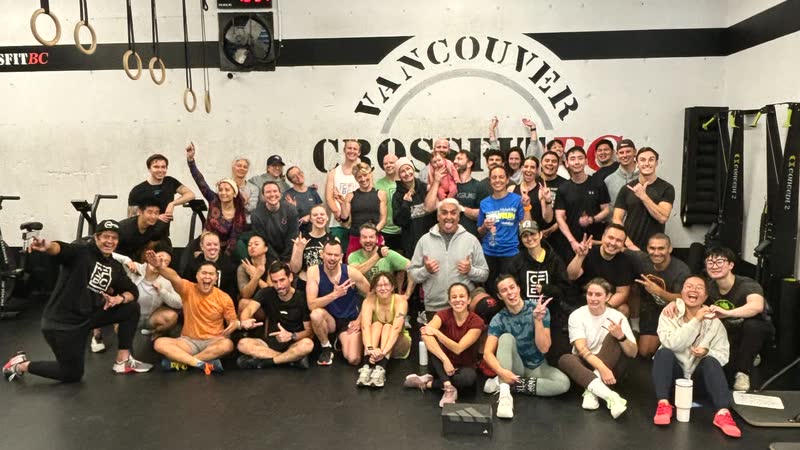
Coach-Led · Beginner-Friendly
CrossFit Vancouver
Get Stronger.
Belong Here.
Four weeks. Seven workouts a week. Zero equipment. Built from a stack of trusted bodyweight training resources and organized so a true beginner can actually finish it.
3 strength · 2 conditioning · 2 mobility. Sundays off.
Start Week 1At a glance
Same shape every week – what changes is the intensity. By week 4 you'll be hitting workouts that would have flattened you in week 1.
Two lower-body / push-pull splits and one mixed day. Slow, controlled reps. Quality over speed.
Short metcons inspired by CrossFit benchmarks (Cindy, Tabata, AMRAPs). Scaled to where you actually are today.
Hips, ankles, t-spine, hamstrings. The work that keeps the other 5 days feeling good.
Sundays off. Sleep, eat, recover. This is when adaptation actually happens.
Learn the patterns. Easy reps, perfect positions, full rest.
Goal: own the positions. No clock.
If you finish in 40s, you have 50s rest.
Inspired by CrossFit benchmark Cindy, scaled for week 1.
Same patterns, more reps, less rest. Add range of motion.
Score = lowest round in each Tabata.
Cap at 12 minutes. From the CrossFit no-equipment metcons list.
Harder variations of the same movements. Real metcons.
Aim for 8+ rounds.
Adapted from CrossFit Alpha.
Repeat week 1's benchmarks at higher quality. See how far you've come.
Write your numbers down.
The CrossFit benchmark. Compare to week 1.
Inspired by Murph. Full version is 1 mile run, 100 pull-ups, 200 push-ups, 300 squats, 1 mile run.
Every movement has an easier and harder version. Use the one that lets you keep good form for every rep.
Push-up too hard → hands on a counter or wall
Squat too deep → squat to a chair, stand up, repeat
Pull-ups not happening → rows under a sturdy table
Burpees brutal → step back instead of jumping
Plank wobbly → drop to forearms or knees
Lunges painful → shorten the step
Do I need any equipment?
No. A sturdy chair or table for rows is helpful but optional. Everything else is just you and the floor.
What if I miss a day?
Just pick up where you left off. Don't try to cram two days into one – the program is built around recovery, not catch-up.
I'm completely new to working out. Is this safe?
Yes. Every movement has a scaling option (incline push-ups, chair rows, step-back burpees). Start with the easiest version and only progress when it feels easy.
What if a workout feels too easy?
Add 2–3 reps to each set, slow the tempo down (3 seconds on the way down), or shorten the rest. Don't skip ahead – week 4 will get you.
What comes after 30 days?
Come into the gym. Most people who finish this plan are ready for our 5-Day Foundations program – coached, in person, and built around what you've already learned.
Where did these workouts come from?
Pulled from a stack of trusted bodyweight resources: the CrossFit Bodyweight Workout Resource by Shane Skowron, the Beginner Bodyweight Workout, the Cardinal Bodyweight Strength Program, and Travel WODs – then organized into a beginner-friendly 30-day arc.
Linda K.
Google Review
You've built a base. The next step is having a coach watch your reps, dial in your positions, and program the next 90 days for you. Three free classes, no commitment.
New athletes usually start with Coach Ciara Pletcher, who coaches our bodyweight and skill progressions. When you're ready for load, move into our CrossFit classes or keep your joints healthy with the mobility program. If you want more context, read why 30-day resets actually work, our guide on why deadlifts are so functional, and training after 40, or browse member stories from neighbours training at our Mount Pleasant gym.
CrossFit at CrossFit BC
Coached group classes, scaled to any level, in Vancouver since 2008.
Why participation charts miss the point, and how a race fits inside a lifelong training practice.
New to CrossFit? How beginners start safely, what the first class feels like, and 3 free classes.
A step-by-step first-timer path: what to bring, what happens in class, and how scaling works.
The coaching, scaling, and community signals that make a gym genuinely beginner-friendly.
An honest comparison of coaching, programming, accountability, community, and cost for new lifters.
A minute-by-minute walkthrough so nothing about your first class feels unknown.
How the two formats differ and which is the better first step for a beginner.
Training around Olympic Village, Mount Pleasant, False Creek, and East Van: transit, parking, and options.
What a typical CrossFit class looks like, week to week.
One of Vancouver's official HYROX Training Clubs, coached classes weekly.
The honest answer, plus how coaching and scaling keep first-timers safe.
Can't do a pull-up yet? How a coach scales load, range, movement, and volume so any workout fits you.
What every coach wishes you knew before your first class: scaling, technique, rest, gear, and community.
Motivation fades. A coach, a plan, and a community are what keep you consistent when willpower runs out.
A coach's report on what functional fitness is, how it's trained, and how to start.
Your on-ramp: learn the movements before group classes.
CrossFit programmed for adults 60+ who want strength for life.
See every class time across the week.
Meet the team. Average 10+ years of coaching experience.
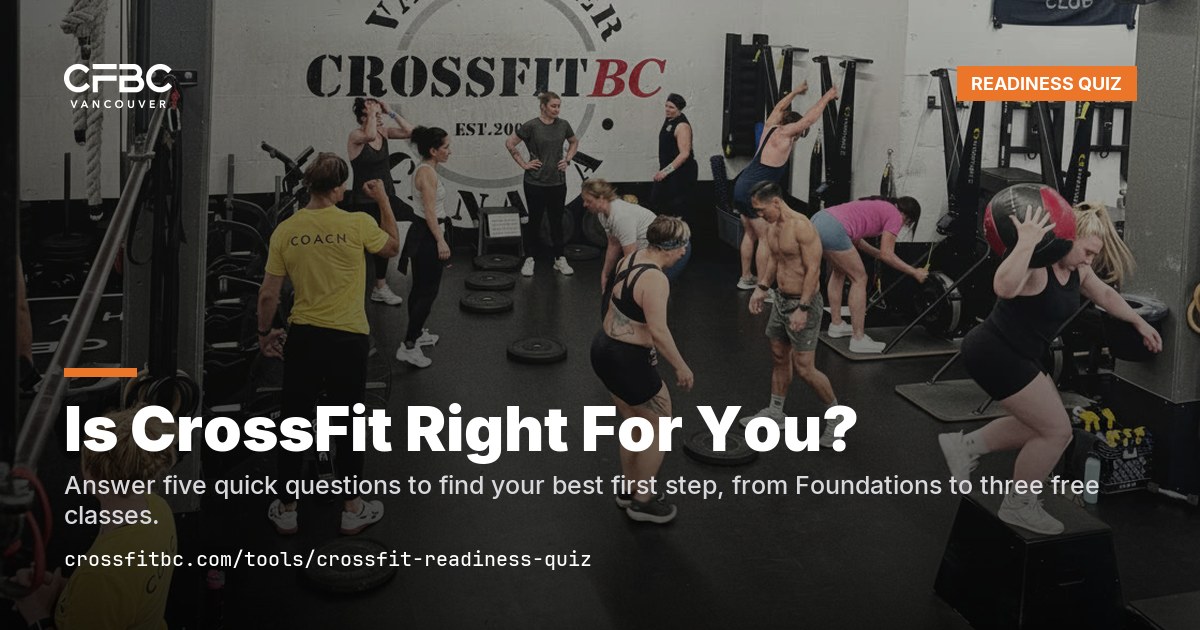
A 2-minute check to see how ready you are for your first class.
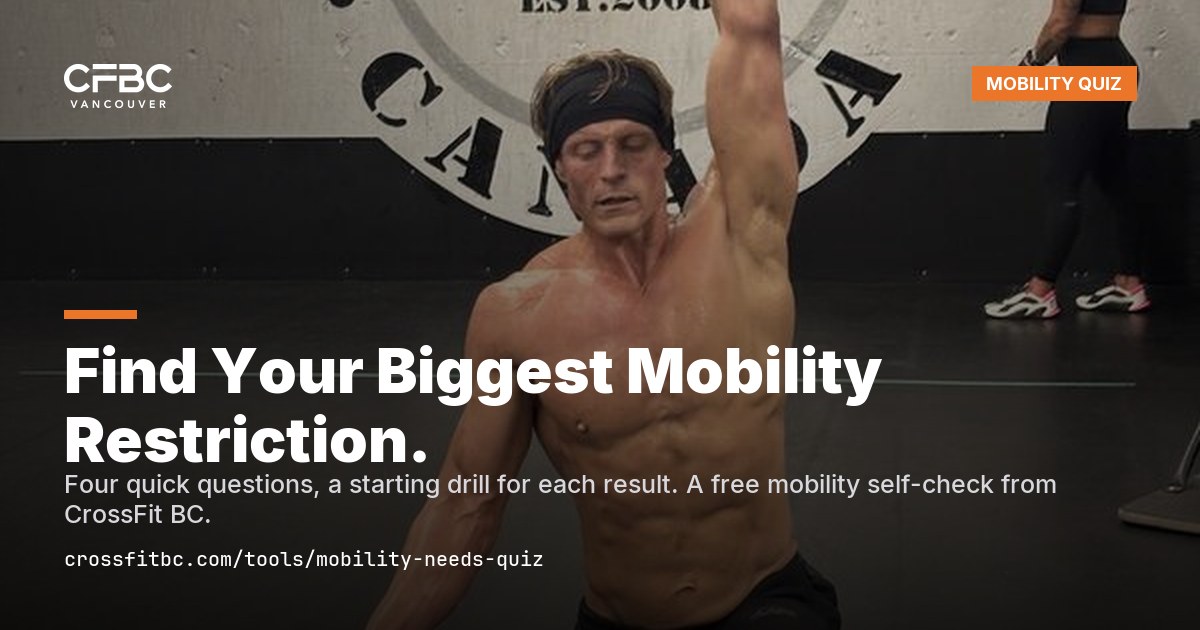
Spot the restriction to work on before you load the movements.
How to build up to Murph safely, with a scalable plan for every level.
Why the community feels different, and what that culture actually looks like day to day.
The movement benchmarks we coach toward, from your first class to advanced skills.