Training After 40: The Science of Building Strength That Lasts
You do not lose strength because you turned 40. You lose it because you stopped lifting heavy things, and the cost compounds every year you delay starting again.
Watch who is still carrying their own groceries up three flights of stairs at 70, or hauling a kayak off the roof rack at 65. The number is small, and the reason is not biology.
Strength that lasts is a healthspan investment. Start with what healthspan means and why it lasts.
It is a story we have been telling ourselves for 40 years: that lifting after a certain age is dangerous, that cardio is enough, that the body should be treated more gently as it gets older.
The science says the opposite. One of the most consistent findings in the longevity literature is that the people who stay strong, stay independent, and live longer are the ones who keep lifting heavy things on purpose, for decades. Not lightly. Not occasionally. Heavily and consistently, into their 60s, 70s, and beyond.
Here is the case for strength training after 40: the four lifts that matter most, and the weekly template we use with the largest group of long-tenured members at CrossFit BC.
The myth that nearly cost a generation their independence
For decades, the standard advice for anyone over 40 was clear: protect the joints, ease into it, stick to machines, keep the weight light. The result was predictable. An entire generation arrived at 65 with sarcopenia, fragile bones, and the kind of weakness that turns a slipped curb into a hip replacement.
The research has caught up. Studies on adults in their 60s, 70s, and even 90s consistently show that progressive resistance training builds muscle, strengthens bone, and restores function at every age tested. The body that adapts to a heavy squat at 25 still adapts to one at 65. Slower, yes. But the adaptation is the same.
Why strength matters more than cardio after 40
This is not a knock on cardio. Aerobic capacity matters. The point is that most adults over 40 already do some form of cardio. Walking, hiking, the occasional run, a spin class. What they almost universally skip is heavy resistance training, and the absence of it is what drives the cliff in healthspan.
Three reasons strength deserves the top of your priority list:
- Muscle is the organ of longevity. Lean mass regulates blood sugar, hormonal balance, and the inflammatory profile that drives most chronic disease. You cannot supplement your way around it.
- Bone responds to load. Bone density does not respond to walking. It responds to the mechanical signal of heavy compound lifts. This is the entire conversation around osteoporosis prevention.
- Function is non-negotiable. Standing up from a low chair, lifting a grandchild, carrying groceries up the stairs at 75. These are strength tasks. They are trainable, and they are losable.
The four lifts that do most of the work
You do not need fifteen exercises. You need four patterns, trained heavily, on a schedule you can hold for years.
| Lift | What it builds | What it protects |
|---|---|---|
| Squat (back or front) | Quad, glute, and trunk strength. Bone density in the spine and hips. | The ability to stand up from any chair, anywhere, for the rest of your life. |
| Deadlift (conventional or trap bar) | Posterior chain strength. Grip. Whole-body coordination. | Lower back integrity. The ability to pick things up safely at 70. |
| Press (overhead or bench) | Upper-body strength, shoulder health, scapular control. | Reaching, lifting overhead, breaking a fall, every push pattern in life. |
| Pull (chin-up, row, or assisted) | Back strength, grip, posture, scapular stability. | Shoulder health, posture, the upper-body counter to a sedentary day. |
That is the entire menu. Two squats, two pulls, two presses per week is enough volume to drive adaptation at every age. Anything beyond that is an optimization, not a foundation.
The 2-day-a-week template that beats nearly everything fancier
This is the template we coach for working adults over 40 who want strength to compound for the next thirty years. Two strength sessions per week. Optional aerobic work on the other days. Recovery treated as a session.
Run that template for three years and you will be stronger at 50 than most adults are at 25. Run it for ten and you will redefine what aging looks like in your family.
Mistakes we see most often after 40
- Going too light, forever. Eight reps with the pink dumbbells is a warm-up, not a stimulus. The body adapts to the load you challenge it with. Light forever means weak forever.
- Skipping the squat and the deadlift. These two lifts do more for healthspan than any other movement on earth. Skip them and you give back the entire premise.
- No coach, no progression. Form deteriorates without eyes on it. Load stalls without a plan. A coached program in your 40s and 50s is one of the highest-return purchases you will ever make.
- Treating recovery as optional. Sleep, protein, stress management. The body after 40 is less forgiving of neglect here. Train hard, recover harder.
What this looks like at CrossFit BC
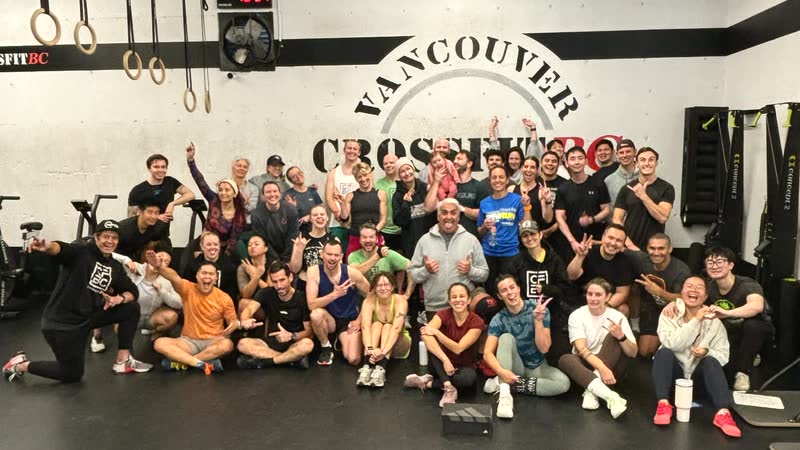
The members who join CFBC in their 40s and stay into their 60s share a pattern. They started in our Foundations program, learned the four lifts under a coach, and built a base of competence that let them train alongside everyone else for the next twenty years. They are the strongest, leanest, most independent adults in their friend groups, and most of them did not lift seriously before 40.
If you want the broader case for training both strength and engine together, see Why the Future Belongs to the Hybrid Athlete. If you want a recovery primer that respects training over 40, our work on recovery and biometrics covers it.
Where to start
The single highest-return decision you can make in your 40s or 50s is to learn the four lifts properly under a coach, and then run them on a simple schedule for the next thirty years. It is not glamorous. It is the closest thing to a guarantee in fitness.
Ready to build strength that lasts? Start with our Foundations program or book a free intro. We coach adults from 25 to 75, and the strongest 60-year-olds in the room almost always started here.