What actually changes for women over 40
Perimenopause is the transition phase before periods stop, and it commonly begins in the early to mid 40s. Estrogen does not drop in a tidy line. It swings, and those swings show up in training long before anyone uses the word menopause.
- Muscle: estrogen supports muscle maintenance, so lean mass is harder to hold and easier to lose.
- Bone: bone loss accelerates around the menopause transition, which is why loading the skeleton matters now.
- Sleep: night waking and hot flashes are common, and lighter sleep slows recovery from hard sessions.
- Recovery and stress: many women notice that the same training week leaves them more fatigued than it used to.
- Body composition: waist circumference and body fat often shift even when the scale barely moves.
The strength plan: two to three sessions a week
The research base for resistance training through and after the menopause transition is consistent: progressive loading is associated with maintained or improved bone density, better lean mass, and improved metabolic markers. Two to three sessions a week is enough to get most of that, and it is a schedule real people keep.
| Day | Focus | Why it is there |
|---|---|---|
| Monday | Full-body strength, heavier | Squat, hinge, press. Loading for bone and muscle. |
| Tuesday | Easy aerobic or walk | Keeps the engine going without adding recovery cost. |
| Thursday | Full-body strength, moderate | Pull, carry, single-leg work. Balance and hips. |
| Saturday | Class or mixed conditioning | Short intense pieces, coached and scaled to the day. |
| Rest days | Genuinely restful | Where the adaptation actually happens. |
Lift heavy enough to count
Light weights for high reps feel productive and do very little for bone. The loading that bone responds to is heavy and progressive, which is why the sets that matter are the ones where the last two or three reps are genuinely hard. Under coaching, that is safe and learnable at any starting point.
Add impact where it is appropriate
Short bouts of impact, such as low box step-downs, skipping, or light jumping, are associated with bone benefit alongside lifting. This gets scaled or skipped for anyone with a low bone density diagnosis or pelvic floor symptoms, and that is a coach conversation, not a guess.
Recovery, sleep, and intensity you can actually absorb
This is the part most women over 40 have to change first. If sleep is disrupted and stress is high, adding more hard sessions does not produce more fitness. It produces more fatigue.
- 1Cap the truly hard sessions at two or three a week and let the rest be moderate.
- 2Protect a consistent sleep window, and treat a bad night as a reason to reduce load rather than skip training.
- 3Use the warm-up as a readiness check. How the first sets feel decides the day's load.
- 4Keep a light log of symptoms alongside training so patterns become visible over a few months.
- 5Strength train year-round. Consistency across seasons beats a perfect eight weeks.
The women who do best through this stage are not the ones who train the hardest. They are the ones who kept training through it and adjusted as they went.
Protein, fuelling, and what is worth your attention
Protein is the lever with the most evidence behind it. Consensus recommendations for older adults sit above the general population guideline, and spreading intake across meals supports the muscle you are training to keep. Practically, that means protein at breakfast, not just at dinner.
- Anchor each meal with a protein source, including breakfast.
- Eat enough overall. Chronic under-fuelling makes recovery and sleep worse, not better.
- Calcium and vitamin D support the bone work you are doing in the gym.
- Creatine monohydrate is one of the better-studied supplements for strength and lean mass in adults.
- Alcohol and caffeine timing are worth testing if sleep is disrupted.
Training this way in Vancouver
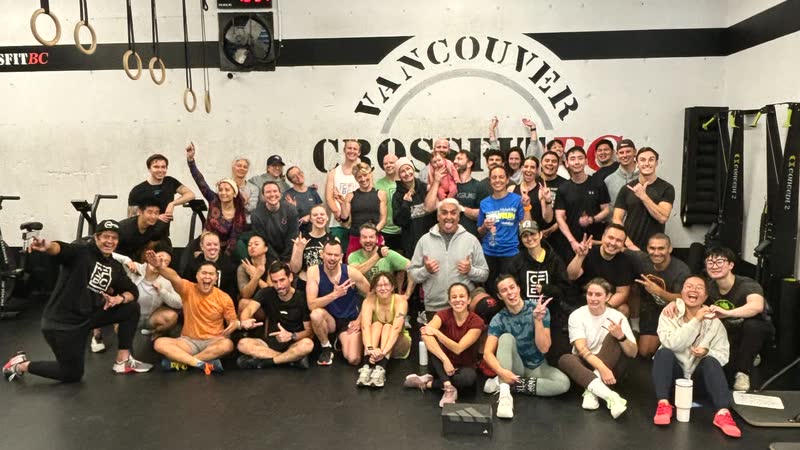
At CrossFit BC in Olympic Village, every class is scaled to the person in front of the coach. Women in their 40s and 50s train in the same room as everyone else, on the same movements, with load and volume adjusted to what their week can absorb. If you would rather start one-to-one, personal training is the quieter on-ramp.
If you are closer to 50 or already past menopause, our guide to strength training for women over 50 picks up exactly where this one leaves off, and the Living Legends program is built for the decades after that.