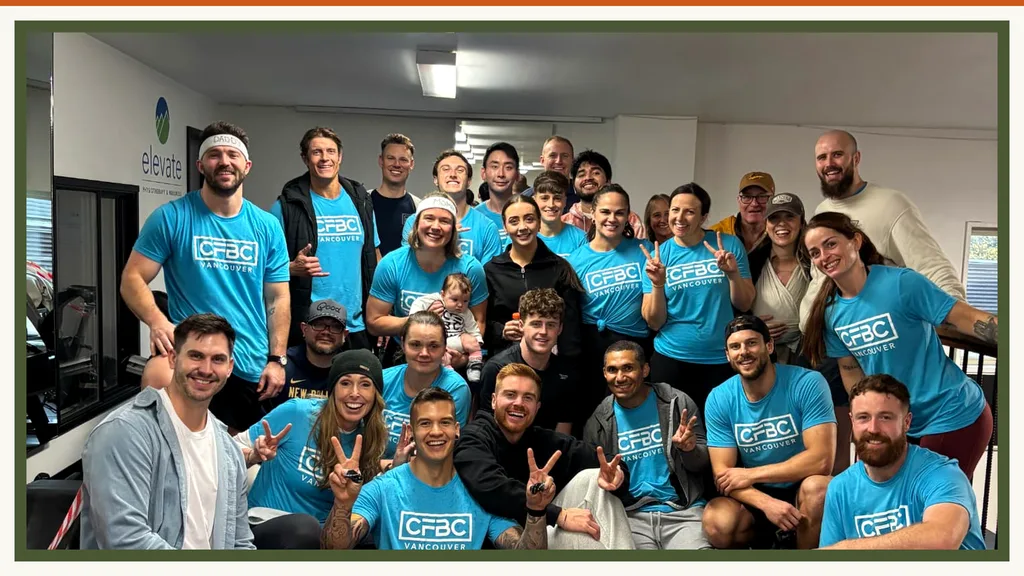
CrossFit BC community in Olympic Village Vancouver – members and coaches together after class
Coach-Led · Beginner-Friendly
CrossFit Vancouver Get Stronger. Belong Here.
Skip to main contentSkip to main content

Sleep and Pre-Sleep Nutrition: The Biggest Recovery Lever You Have

Nobody wants this to be the answer, which is part of why it works so well. Sleep is free, unglamorous and more powerful than anything else on the list.

Coach Dai Manuel, CrossFit BC

Coach Dai Manuel (Coach Moose)

Owner · Lifestyle Mentor · HYROX Performance Coach · CrossFit Level 2 · ACE Certified

Reviewed by Coach Dai Manuel Published September 15, 2026 Updated September 15, 2026 8 min read

Expert consensus work on athletes points to seven to nine hours as the practical target, with regularity mattering as much as duration. Protect it by holding a consistent bedtime, cutting caffeine well before bed, and not going to sleep genuinely hungry after a hard session.

  • Consistency of bedtime is as useful as total hours, and easier to control.
  • Caffeine six hours before bed measurably reduced sleep in controlled research, even when people did not notice.
  • Going to bed hungry after hard training tends to cost you sleep, which is the more expensive loss.
  • A pre-sleep protein serving may support overnight repair. It is a refinement, not a requirement.
  • Alcohol reliably degrades sleep quality even when it helps you fall asleep.

Why sleep outranks everything else on the list

Narrative reviews and expert consensus work on sleep in athletes keep arriving at the same place. Sleep duration and quality are associated with performance, injury risk, mood and illness, athletes routinely get less than they need, and no intervention reliably replaces it.

On the floor it is obvious. The sessions that fall apart are almost never the ones where somebody skipped their electrolytes. They are the ones after a five-hour night.

Your caffeine cut-off is earlier than you think

A controlled study gave people caffeine at zero, three and six hours before bed and measured their sleep. Even the six-hour dose meaningfully reduced total sleep time, and the participants largely did not report noticing it. That last part is the useful bit. Feeling unaffected is not evidence of being unaffected.

If you go to bed at 10pm, that puts the last coffee around 3 or 4pm for many people. If your 5pm espresso is genuinely non-negotiable, that is your choice to make, but make it knowingly.

Should you eat before bed?

The blanket advice not to eat after a certain hour does not survive contact with people who train in the evening. Going to bed genuinely hungry after a hard session usually means worse sleep, and worse sleep costs more than a late meal ever did.

There is also a small positive case. Research on pre-sleep protein ingestion suggests a substantial serving before bed, often around forty grams of a slower-digesting protein such as casein, is digested and used overnight and can support the adaptive response to training.

The short list that actually works

  1. 1Pick a bedtime you can hold five nights out of seven. Regularity beats heroics.
  2. 2Set a caffeine cut-off around six hours before that bedtime.
  3. 3Keep the bedroom dark and cool enough that you are not kicking the duvet off at 3am.
  4. 4Treat alcohol as a sleep cost, because it is one, even when it helps you drop off.
  5. 5If you train late and cannot switch off afterwards, try moving one session a week earlier and see what happens.

For the sleep-specific tools we publish, including a structured way to rebuild your sleep opportunity, see the Recovery Hub.
Sources and references

Your Next Step

The Deep Sleep Protocol

Clinical-grade sleep optimization: architecture, HRV, and shift + travel protocols.

The Deep Sleep Protocol

No spam. Just the guide + helpful tips from our coaching team.

Ready to Start?

Try 3 Classes Free

No commitment, no pressure. Just come meet our coaching team and see what a class feels like.

Try 3 Classes Free

Frequently Asked Questions

How many hours do I actually need?
Expert consensus for athletes generally lands in the seven to nine hour range, with a note that individual needs vary and that regularity matters alongside duration.
Does a nap count?
It helps, particularly after a short night. A twenty to thirty minute nap in the early afternoon is the usual recommendation, before it starts eating into that night's sleep.
Is eating late going to make me gain weight?
Weight follows total intake far more than clock time. A late meal within your normal intake is not the problem it has been made out to be.
What about magnesium or sleep supplements?
Worth far less than a consistent bedtime and an earlier caffeine cut-off. Fix the free things first and see what is left to solve.
I train at 6am. Am I sabotaging my sleep?
Only if you keep the same bedtime you had before you started. Early training works well for plenty of our members, provided the evening moves with it.