
The Sickness-Wellness-Fitness Continuum: Where Do You Sit?
Most people think being 'not sick' means they're healthy. CrossFit challenges that assumption with one of the most important frameworks in fitness. Here's why it matters.
Here's a question most people never ask themselves: where do you actually sit on the health spectrum right now?
Not "Are you sick?" or "Do you feel okay?" but: if we measured your blood pressure, your body fat, your bone density, your blood sugar, your muscle mass, and every other meaningful health marker, would the numbers show that you're moving toward health, or quietly drifting away from it?
That's the question at the heart of one of CrossFit's most important ideas: the Sickness-Wellness-Fitness Continuum.
It's not complicated. It's not academic. It's something you can feel in your own body once you understand it. And once you do, it changes the way you think about fitness entirely.
What Is the Sickness-Wellness-Fitness Continuum?
The concept is beautifully simple. At any point in your life, the state of your health exists somewhere on a continuum that runs from sickness on one end, through wellness in the middle, to fitness on the far end.
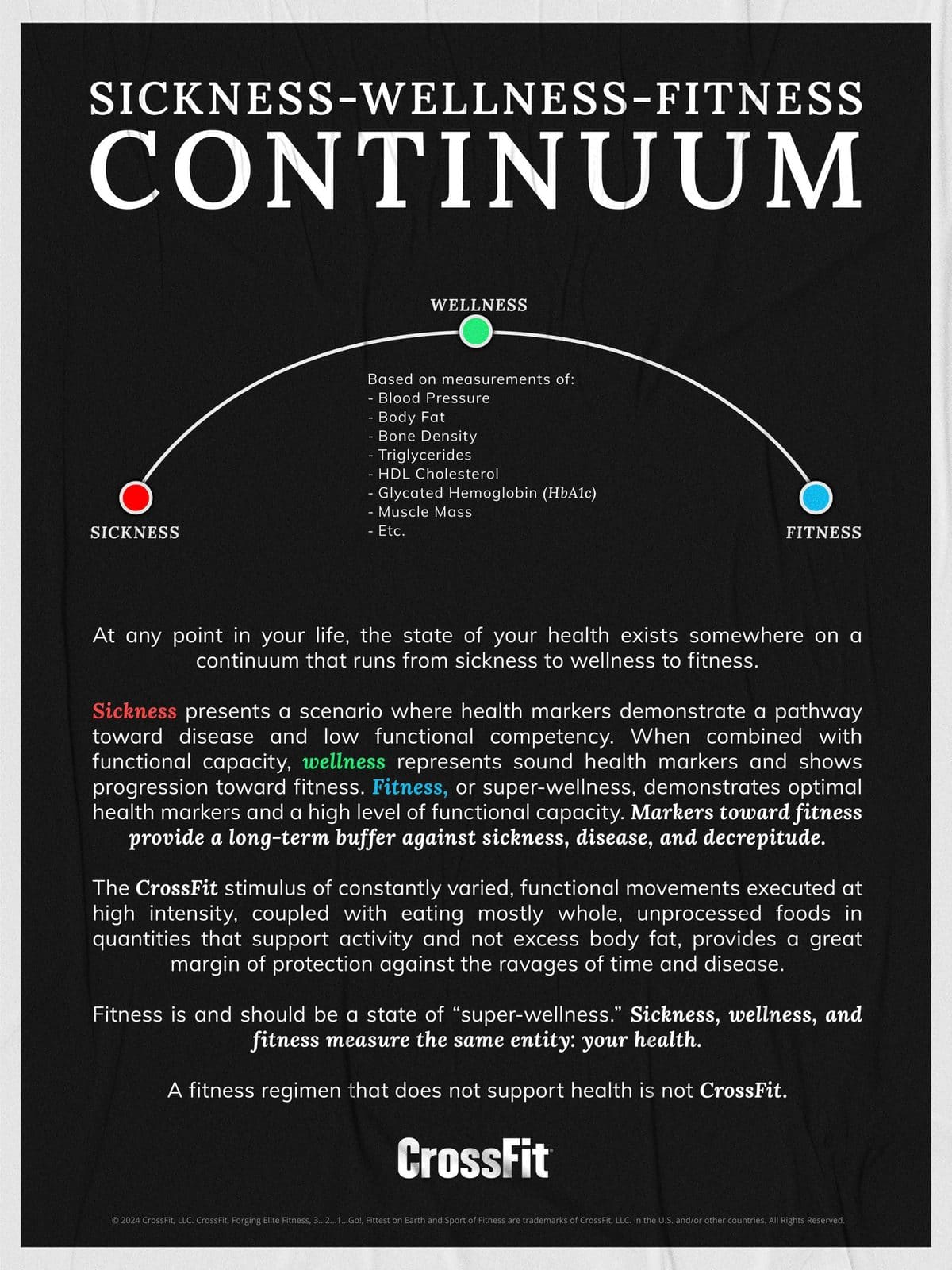
The Sickness-Wellness-Fitness Continuum, as defined by CrossFit. Based on measurable health markers including blood pressure, body fat, bone density, triglycerides, HDL cholesterol, HbA1c, and muscle mass.
This isn't a philosophy. It's based on real, measurable health markers:
- Blood pressure
- Body fat percentage
- Bone density
- Triglycerides
- HDL cholesterol
- Glycated hemoglobin (HbA1c)
- Muscle mass
Each of these markers exists on a measurable spectrum. And the direction you're trending matters more than any single snapshot.
Sickness
On the left end of the continuum, sickness presents a scenario where health markers demonstrate a pathway toward disease and low functional ability. High blood pressure. Elevated blood sugar. Low bone density. Declining muscle mass. These aren't just numbers on a page. They're warning signals that something is heading the wrong direction.
Wellness
In the middle sits wellness. Your numbers are "normal." Your doctor says you're fine. You pass a physical. You feel okay. For most people, this is where the conversation about health ends.
But here's the thing: "normal" isn't the same as "protected." A person sitting in the wellness zone might be one stressful year, one injury, or one decade of inactivity away from sliding toward sickness. There's no buffer.
Fitness (or "Super-Wellness")
On the far right of the continuum is fitness, or what CrossFit calls "super-wellness." This is where health markers don't just look normal. They look exceptional. Strong bone density. Healthy body composition. Excellent cardiovascular markers. Real functional capacity: the ability to move, lift, carry, climb, and do the things life asks of you.
And here's the key insight: markers toward fitness provide a long-term buffer against sickness, disease, and decrepitude.
That buffer matters. A lot.
Watch: The Continuum in Action
A quick visual breakdown of the Sickness-Wellness-Fitness Continuum and why it matters for your health.
Why "Not Sick" Is Not the Same as Healthy
This is the part that clicks for most people when they hear it for the first time.
We've been conditioned to think of health as binary: you're either sick or you're not. You either have a diagnosis or you're "fine." The annual physical becomes a pass/fail test, and if nothing is flagged, you carry on.
The continuum challenges that. It says: sickness, wellness, and fitness measure the same entity, your health. They're not three separate categories. They're three zones on a single spectrum.
A person with "normal" blood pressure, "normal" cholesterol, and "normal" blood sugar who never exercises, eats processed food regularly, and has been slowly losing muscle mass for a decade might look healthy on paper today. But the trend line is pointing the wrong way. They're sitting in wellness, but drifting toward sickness without knowing it.
We see this on the coaching floor more than you'd think. People come in saying, "My doctor says I'm fine, but I don't feel fine." They're tired. They can't keep up with their kids. They're winded going up stairs. Their back hurts all the time. Nothing is technically "wrong," but nothing feels right either.
That's the wellness zone. It's not a destination. It's a waypoint, and which direction you're moving matters far more than where you are today.
Why CrossFit Trains for Fitness, Not Just "Health"
This is where it gets practical. If fitness provides a buffer against sickness, then the goal of training shouldn't be to look a certain way or hit an arbitrary number on a scale. The goal should be to build as much capacity as possible across every measurable marker of health.
That's exactly what CrossFit was designed to do.
The CrossFit stimulus, constantly varied functional movements executed at high intensity, coupled with eating mostly whole, unprocessed foods in quantities that support activity and not excess body fat, provides a great margin of protection against the ravages of time and disease.
Let's break that down:
- Constantly varied: Your body never fully adapts, which means it continues to improve across multiple domains. You're not just good at one thing. You're capable across the board.
- Functional movements: Squats, deadlifts, presses, pulls, carries. These are the movement patterns that keep you independent, capable, and resilient. They build real-world strength, not just gym strength.
- High intensity: Relative to the individual, intensity drives the adaptation. It's what makes the training effective at changing your health markers, not just burning calories.
- Whole, unprocessed food: Nutrition is the foundation. No amount of training will outrun a diet built on processed food. The continuum depends on both movement and fuel.
When you combine all of those elements consistently, your health markers improve. Blood pressure comes down. Body composition improves. Bone density increases. Cardiovascular capacity goes up. You move from wherever you are on the continuum further toward fitness.
And the further you move toward fitness, the more buffer you have. Think of it like financial savings for your body. The more you've invested in your health, the more resilient you are when life throws something at you: an injury, a stressful period, an illness, aging itself.
How We Think About This at CrossFit BC
We talk about the continuum with our members all the time. Not as an academic concept, but as a practical compass for why we train the way we do.
When a new member joins our 30-Day Lifestyle Reset, one of the first conversations is about where they are and which direction they want to move. We're not diagnosing anything. We're asking: what does your body feel like right now? What can you do, and what do you wish you could do? Where do you want to be in a year?
Then we build a plan to move them toward fitness. Not fitness as in "six-pack abs" or "crushing a workout." Fitness as in: your health markers are improving, your functional capacity is growing, and you're building a long-term buffer against the things that steal your quality of life.
That's why our programming includes:
- CrossFit classes that build strength, conditioning, and movement quality across every domain
- HYROX training that combines running and functional stations for total cardiovascular and muscular endurance
- Olympic weightlifting that develops power, coordination, and bone density
- Gymnastics that builds body awareness, control, and relative strength
- Mobility work that keeps your joints healthy and your movement quality high over the long haul
- Living Legends (60+) for adults who want to keep building fitness as they age, not just slow the decline
Every one of these programs moves the needle toward fitness. And the beauty of the continuum is that it doesn't matter where you start. What matters is the direction you're heading.
The Measurable Markers That Matter
One of the things that makes the continuum so powerful is that it's not based on how you feel or how you look. It's based on numbers. Objective, measurable health markers that your doctor can test and that training can change.
Here's what the research tells us about what happens when you train consistently with the CrossFit methodology:
| Health Marker | Direction with CrossFit Training |
|---|---|
| Blood Pressure | Decreases (moves toward fitness) |
| Body Fat Percentage | Decreases (improved body composition) |
| Bone Density | Increases (weight-bearing exercise is protective) |
| Triglycerides | Decrease (cardiovascular risk drops) |
| HDL Cholesterol | Increases (the "good" cholesterol rises) |
| HbA1c (Blood Sugar) | Decreases (better glucose regulation) |
| Muscle Mass | Increases (functional capacity grows) |
This is not speculation. These are well-documented outcomes of consistent functional fitness training combined with whole-food nutrition. And every one of these markers maps directly onto the continuum.
We use DEXA body composition scans as part of our 30-Day Lifestyle Reset for exactly this reason. Not to judge you, but to give you a baseline. Where are you right now? And after 30 days of consistent training and nutrition coaching, where have you moved?
A Fitness Regimen That Doesn't Support Health Is Not CrossFit
This line, straight from the CrossFit methodology, is one of the most important guardrails in the entire system.
It means: if your training is making you hurt, broken, overtrained, or sick, something is wrong. The point isn't to be crushed by a workout. The point is to be healthier because of it.
At CrossFit BC, we take this seriously. Every class is coached. Every movement is scaled to the individual. We don't celebrate going to failure for the sake of it. We celebrate consistency, improvement, and showing up over time.
Because on the continuum, it's not the single heroic workout that moves the needle. It's the thousands of good training sessions, the years of showing up, the nutrition habits that become second nature, and the community that keeps you coming back.
That's what builds a real buffer against sickness. That's what moves you toward fitness.
Where Do You Want to Be?
The continuum isn't meant to scare you. It's meant to empower you.
If you're sitting in the wellness zone right now, feeling "fine" but knowing you could feel better, the good news is: the path from wellness to fitness is well-mapped. It's functional training. It's real food. It's accountability and coaching. It's showing up consistently.
If you're closer to the sickness end and looking for a way out, the same path applies, just with more patience and more support. That's why our coaching team is here.
And if you're already training and want to understand why it matters beyond looking good or hitting a PR? Now you know. You're building a buffer. You're investing in your future self. You're moving the needle on every measurable marker of health.
That's what fitness is for. Not a six-pack. Not a competition score. A long, capable, independent, healthy life.
Ready to start moving toward fitness?
Try a class with us. No commitment, no pressure. Just come see what we do.
Try a Class With Us