
12-Week HYROX Race Prep Timeline for Vancouver Athletes
A week-by-week 12-week HYROX race prep timeline built for Vancouver athletes, from aerobic base through taper. The exact phasing CrossFit BC coaches use to get clients to the start line race-ready.
You signed up. The race is on the calendar. Now the real question, what do the next 12 weeks actually look like?
This is the exact race-prep timeline we use with HYROX athletes at CrossFit BC in Vancouver. It is not a magic plan. It is a phased structure that lets you build aerobic base, then race-specific power, then sharpen, then taper, without falling apart in week 8 like most self-coached athletes do.
If you are still figuring out the basics, start with our beginner HYROX training guide first. If you already know the format and just need the calendar, keep reading.
Who This Timeline Is For
This 12-week plan assumes you already have a baseline of general fitness, you can run 5K without stopping, you've picked up a barbell before, and you train at least 3 days a week. If that sounds like you, this timeline will get you to the start line race-ready.
It's built specifically for:
- First-time HYROX racers with a CrossFit, running, or general fitness base who have signed up for a race 10–14 weeks out.
- Returning racers who want a structured rebuild after a layoff or who finished their last race feeling under-prepared.
- CrossFit athletes who are race-curious and want to layer HYROX-specific work onto their existing programming.
- Self-coached athletes who keep blowing up at week 7 because they have no phasing, no taper, and no plan beyond "train hard."
It is not the right plan for total beginners, if you're brand new to fitness, start with our beginner HYROX training guide and give yourself 6 months before your first race. It's also not designed for elite athletes targeting a top-10 finish; that requires individualised programming, which is exactly what we do inside our HYROX program.
The 12-Week Structure at a Glance
Twelve weeks splits cleanly into four 3-week blocks, each with a different job:
- Weeks 12–10, Aerobic Base. Build the engine. Long Zone 2 runs, easy ergs, station familiarisation at light loads.
- Weeks 9–7, Strength + Power Endurance. Add load. Heavier sled sessions, sandbag intervals, tempo running.
- Weeks 6–4, Race-Specific Intensity. Practice the actual race. Run-erg-station combos at goal pace.
- Weeks 3–2, Sharpening. Higher quality, lower volume. Race-pace simulations.
- Week 1, Taper. Maintain feel, drop volume by 50–60%, sleep, eat, show up fresh.
The 12-week snapshot
| Block | Weeks | Focus | Key sessions |
|---|---|---|---|
| Aerobic Base | 12–10 | Build the engine | Zone 2 runs, long ergs, light station work |
| Strength + Power Endurance | 9–7 | Add load under fatigue | Heavy sleds, sandbag intervals, tempo runs |
| Race-Specific Intensity | 6–4 | Train the race | Compromised SIM-ilar sessions at goal pace |
| Sharpening | 3–2 | Express the fitness | Short, sharp race-pace work, lower volume |
| Taper + Race Week | 1 | Arrive fresh | 50–60% volume cut, sleep, fuel, race |
That is the macro view. Now the week-by-week.
Weeks 12–10, Build the Aerobic Base
Why this block matters
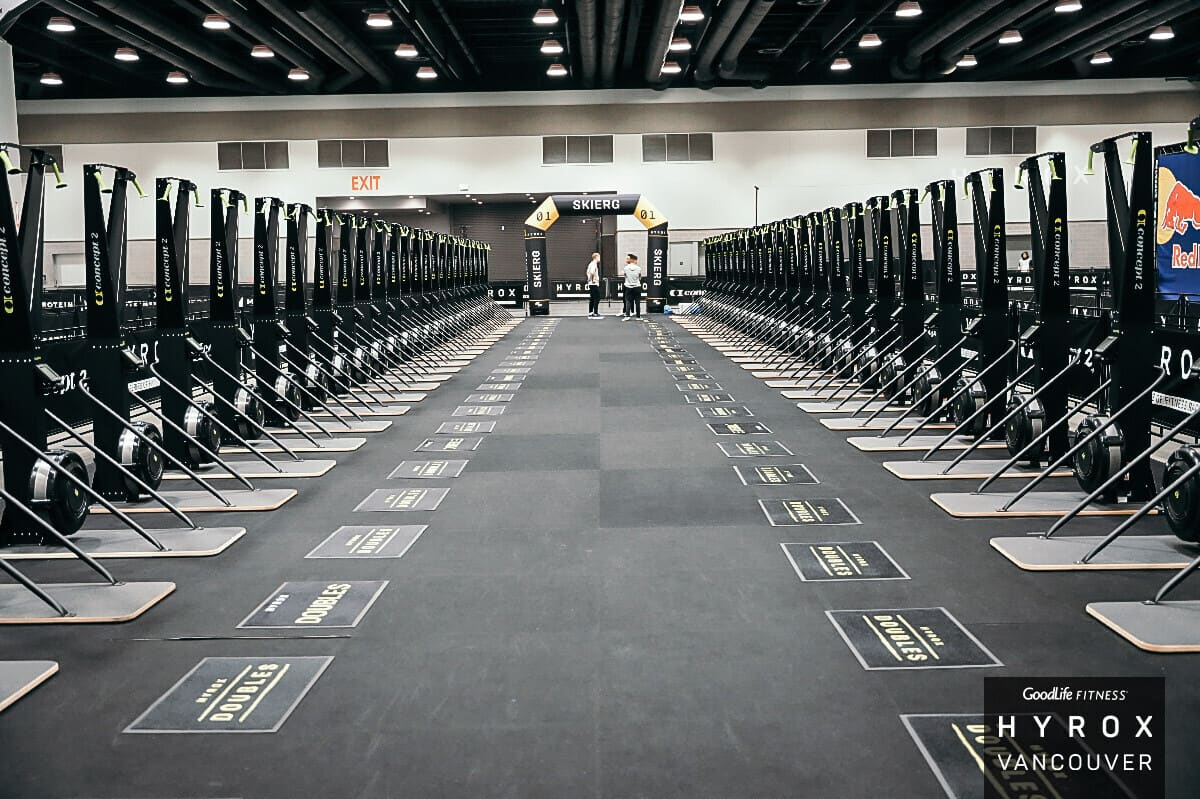
HYROX is roughly a 60–90 minute event for most age-groupers. That makes it an aerobic race, not a sprint. If your engine is small, the strongest sled push in Vancouver will not save you. This block is about making the engine bigger before we ask it to work harder.
What a typical week looks like
- 2× Zone 2 runs, 40–60 min easy, nasal-breathing pace. Stanley Park seawall is perfect.
- 1× long erg session, 30 min row or ski at conversational pace.
- 2× HYROX strength + station familiarisation, light sleds, technique reps on wall balls, burpee broad jump pacing.
- 1× full rest day.
If you are not sure whether your aerobic base is where it needs to be, our HYROX PFT vs Output HCT benchmarking guide walks through the test we run on every athlete in week 12.
Weeks 9–7, Strength and Power Endurance
Why this block matters

The stations are where most Vancouver athletes lose 5–10 minutes on race day. Sled push, sled pull, sandbag lunges, and farmers carry are all expressions of strength under fatigue. You cannot fake this. You have to train it.
What a typical week looks like
- 1× heavy lower-body day, back squat, RDL, accessory.
- 1× heavy upper / pull day, strict pulling, pressing, core.
- 2× station-specific intervals, e.g. 4 rounds of sled push 50m + 400m run.
- 1× tempo run, 4–6 km at comfortably-hard pace.
- 1× active recovery, easy bike, mobility, sauna.
This is also when we want to make sure you are not losing your strength to chasing race-pace runs, a classic mistake.
Want this built around your race date, not a generic plan?
Our HYROX Program at CrossFit BC runs this exact 12-week periodisation, adjusted weekly to how you're actually responding. You get:
- A 12-week plan mapped to your race, Vancouver, Calgary, Seattle, anywhere on the circuit.
- Real HYROX equipment, race-spec sleds, SkiErg, sandbags, wall balls, every session.
- Coach eyes on every block, benchmarks at week 12, 6, and 3, with phase adjustments based on your data.
- A training community racing the same circuit you're prepping for.
Weeks 6–4, Race-Specific Intensity
Why this block matters
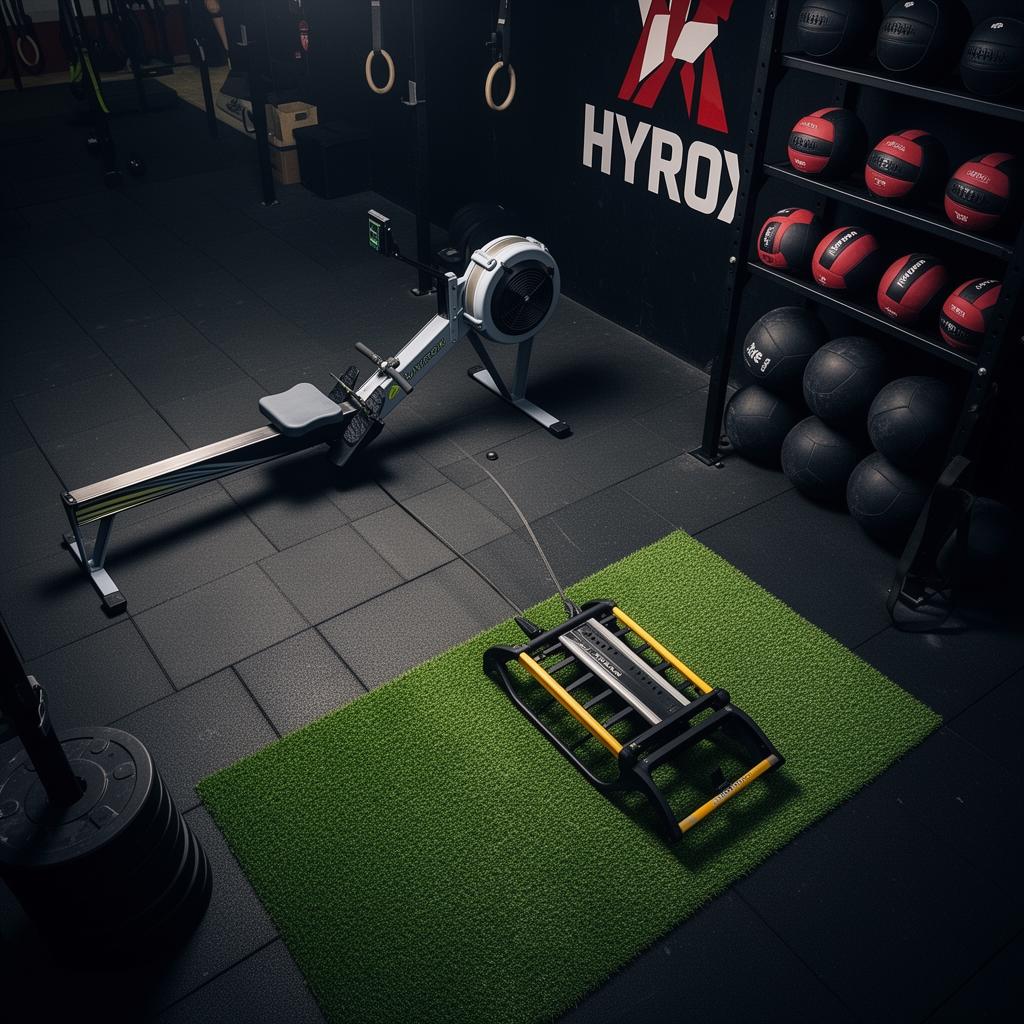
Now we stop training the parts and start training the race. The transition from running to a station and back to running is its own skill. Heart rate spikes. Legs feel like cement. You need reps in that exact pattern.
What a typical week looks like
- 1× HYROX simulation (compromised), half-race volume at goal pace. e.g. 4 stations + 4 runs.
- 1× station threshold, wall balls + row + burpee broad jumps repeated for time.
- 1× long run with intervals, 8 km with 4× 1km at goal race pace.
- 1× strength maintenance, squat, pull, press at 75–80%.
- 1× easy aerobic, 45 min Zone 2.
- 1× rest, 1× active recovery.
Dial in your race-pace targets
By the end of the race-specific block (around week 4), you should know exactly what 1K split you're holding under fatigue. Plug your goal finish time into our HYROX Run Pace Band Calculator to lock in target splits for every run leg before the sharpening block.
Weeks 3–2, Sharpening
Volume drops about 20%. Quality goes up. The job here is not to get fitter, it is to express the fitness you have already built. Two short, sharp HYROX-specific sessions per week, one full race-pace 1km repeat day, and lots of sleep.
Stop chasing PRs in the gym. Stop adding new movements. Stop testing yourself for the Instagram story. The race is the test.
Week 1, Taper and Race Week
Volume
Cut total training volume by 50–60%. Keep intensity touches short and sharp, a 5-minute race-pace primer two days out is enough. The goal is to arrive at the start line with fresh legs and a sharp nervous system, not exhausted from one last "test."
The race-week checklist we give every CrossFit BC athlete
- Monday: easy 30 min Zone 2 + 10 min mobility. Nothing else.
- Tuesday: short station primer, 2 rounds of 200m run + 10 wall balls + 20 burpees. Sharp, not tired.
- Wednesday: rest. Sleep 9 hours. Carb up gradually.
- Thursday: 20 min easy run + 4× 100m strides. Pack your race kit.
- Friday: rest, light walk, hydrate, race-day plan reviewed with your coach.
- Saturday (race day): arrive 90 min early, warm up 25 min, hit the line.
For the full pre-race breakdown, pacing, fuelling, what to wear, transitions, read The HYROX Race-Ready Playbook.

Race-Day Fueling and Pacing
By the race-specific block you already know your splits. The piece most Vancouver athletes leave on the table is fueling and pacing, the difference between fading at the sandbag lunges and finishing strong.
Fueling the week of
- Carbohydrate, not restriction. Top up glycogen across the final 2–3 days with familiar carbs. Race week is not the time to cut.
- Hydration starts Thursday. Steady water and electrolytes across the week, not a panic litre on the start line.
- A race-morning breakfast you have tested. Eat it 2–3 hours out. Nothing new on race day, ever.
Pacing the eight runs
HYROX is won and lost on the runs, not the stations. Go out 10–15 seconds per kilometre slower than your solo 1K feels, bank nothing on the first two runs, and let the field come back to you. Lock your targets with our HYROX Pace Band Calculator, and read the full breakdown in why more running will not save your HYROX race.
Common Mistakes Vancouver Athletes Make
- Skipping the base block. "I already run." Running 5km on the seawall is not the same as 8km broken up by max-effort stations. Build the base.
- Going too hard, too often. Three hard sessions a week is plenty. Five is how you arrive at the start line with a tweaked hamstring.
- Ignoring the sled. If you do not have access to a real HYROX sled, and most rooms in the city do not, you need a plan. Our HYROX program runs them every week.
- Tapering wrong. Taper is not "do nothing for 7 days." It is reduced volume, maintained intensity. There is a difference, and it shows up on race day.
How CrossFit BC Coaches This in Vancouver
Every athlete in our HYROX program gets a 12-week timeline mapped to their specific race date, Vancouver, Calgary, Seattle, or anywhere else on the circuit. We benchmark in week 12, re-test in week 6, and run a full race simulation in week 3. Coaches adjust the plan each week based on how you are actually responding, not how the spreadsheet says you should be.
If you would rather not coach yourself through this, that is exactly what we are here for. Not sure which entry point fits? Compare HYROX Foundations vs Race Ready to see which program matches where you are right now. Brand new to the sport? Start with What is HYROX or our beginner HYROX training guide for Vancouver. And if you're still vetting where to train, here's what to actually look for in a Vancouver HYROX gym.
Related HYROX reads
- The HYROX Race-Ready Playbook, pacing, fuelling, transitions, and exactly what to do in the final 7 days before the start line.
- Beginner HYROX Training in Vancouver, if you're newer to the sport, this is where to start before you commit to a 12-week build.
- HYROX PFT vs Output HCT, the two benchmark protocols we use to test Vancouver athletes at week 12, week 6, and week 3 of the timeline.
- CrossFit vs HYROX, how the two sports differ and why a CrossFit base transfers so well onto the HYROX timeline.
- Why more running will not save your HYROX race, where the runs actually get won, and the station work that protects them.
- What to look for in a Vancouver HYROX gym, the equipment and coaching to check for before you commit to a 12-week build.