
HYROX vs Deadly Dozen: What's the Difference? (2026 Coach's Guide)
Two hybrid races. Same Instagram aesthetic. Completely different sports. Here is the only HYROX vs Deadly Dozen comparison you need, written by coaches who prep athletes for both.
Two hybrid races. Same Instagram aesthetic. Genuinely different demands. If you are trying to decide between HYROX and Deadly Dozen, this is the only comparison you need: written by coaches who have prepped athletes for both, in the same gym, in the same season.
If HYROX is new to you, here is a full breakdown of what HYROX is and why everyone's training for it.
By the end of this guide you will know exactly which race fits your fitness, your personality, and your calendar, and how to start training for it this week. If you land on HYROX, our coached HYROX training in Vancouver covers the stations, the weights, and the running rhythm in one plan.
HYROX vs Deadly Dozen at a Glance
If you only read one section, read this one.
| HYROX | Deadly Dozen (Track) | |
|---|---|---|
| Format | 8 runs + 8 fixed stations, identical worldwide. | 12 runs + 12 fixed labours, published in advance. |
| Setting | Indoor arena, flat course. | Track (Dhillon Track, UBC for Vancouver 2026). |
| Total running | 8 km, flat, broken into 1 km segments. | 4.8 km, broken into twelve 400 m segments. |
| Equipment | Machines and strength: ski erg, sled, rower, wall balls, sandbag. | Free weights and bodyweight only: kettlebell, dumbbell, weight plate. No sleds, ergs, or wall balls. |
| Divisions | Singles (Open / Pro), Doubles, Relay. | Solo, Pairs, Relay. |
| Best for | Athletes who like a repeatable, measurable benchmark. | Athletes who like more running reps, transitions, and team formats. |
| Vibe | Polished, global, competitive. | Community, team-friendly, festival energy. |
Still on the fence after that? Good, the rest of this guide is built to help you decide with confidence.
Video credit
Martin Boyce(opens in a new tab)
A quick visual primer on the Deadly Dozen format before we compare it to HYROX side by side.
The Real Difference: Machines and Distance vs Free Weights and Reps
Everything else flows from this. Both races are fixed and rehearsable, so the difference is not predictability, it is what you are running and lifting.
HYROX is eight 1 km runs, each followed by one of eight stations in the same order every time: ski erg, sled push, sled pull, burpee broad jumps, rowing, farmers carry, sandbag lunges, wall balls. The running is the biggest single chunk (8 km), and the stations lean on machines and a heavy sled.
Deadly Dozen (Track) is twelve 400 m runs, each followed by one functional Labour, back-to-back. The twelve Labours, in order, are: farmers carry, kettlebell deadlift, dumbbell lunge, dumbbell snatch, burpee broad jump, goblet squat, front carry, push press, bear crawl, clean and press, overhead carry, and devil press. It uses only bodyweight, kettlebell, dumbbell, and weight-plate movements, with no sleds, ergs, or wall balls. You get more runs, shorter runs, and far more transitions.
Neither approach is better. They reward slightly different athletes:
- HYROX rewards strong runners who can grind a heavy sled and hold pace over longer 1 km intervals.
- Deadly Dozen rewards athletes with strong grip, carries, and repeatable free-weight cycling who thrive on frequent run-to-labour transitions.

Which Race Is Right For You?
Use this quick filter. Be honest, not aspirational.
Pick HYROX if…
- You like a clear plan and a benchmark you can compare against athletes worldwide.
- You enjoy longer, steady 1 km running intervals.
- You have access to a gym with sleds, ergs, and wall balls.
- You want a global standard (and possibly to qualify for World Championships).
- You prefer an indoor, weather-proof race.
Pick Deadly Dozen if…
- You like frequent, shorter running reps with lots of transitions.
- You have strong grip, carries, and free-weight conditioning.
- You want a race with social Solo, Pairs, and Relay team formats.
- You want a race that feels like a community event with your crew.
- You are training in Vancouver and want a summer race on the track at UBC.
Do both if…
You have at least 8 to 12 months of consistent training and want a full racing year. Many of our members race HYROX in the winter (indoor, structured) and Deadly Dozen in the summer (track, team-focused). The fitness overlap is roughly 80%.
Want a coach to help you choose? Take the free 2-minute Coaching Fit match, it pairs you with the coach and program path most aligned with your goals.
The Running, the Movements, and the Difficulty
Running
HYROX: 8 km total, flat course, broken into eight 1 km segments. If you can hold a comfortable 5:30 to 6:00/km pace, you are in the game.
Deadly Dozen: 4.8 km total, broken into twelve 400 m segments. The runs are shorter, but there are more of them and a Labour after every single one, so compromised running and quick transitions decide your day.
Movements
HYROX stations are eight gym movements you can drill weekly: ski erg, sled push, sled pull, burpee broad jumps, rowing, farmers carry, sandbag lunges, and wall balls. Train at a well-equipped gym and race day becomes execution, not improvisation.
Deadly Dozen Labours are twelve free-weight and bodyweight movements, also fully published: farmers carry, kettlebell deadlift, dumbbell lunge, dumbbell snatch, burpee broad jump, goblet squat, front carry, push press, bear crawl, clean and press, overhead carry, and devil press. No sleds, ergs, or wall balls. For a station-by-station strategy, read our 12 Labours movement breakdown.
Which one is harder?
Honest answer: it depends on you.
- HYROX is harder for people who underestimate the running. The sled in station 2 feels manageable. The sled in station 6, after 5 km of running and four other stations, feels like a different exercise.
- Deadly Dozen is harder for people with a weak engine for transitions. Twelve runs and twelve Labours back-to-back punish anyone who cannot settle their heart rate quickly and keep cycling reps on tired legs.
How to Train for HYROX (in Plain English)
A simple weekly skeleton that works for most adults:
- 2× CrossFit / strength sessions to build the engine and the strength base that protects you under fatigue.
- 1× HYROX-specific session: 1 km runs alternated with sled, ski erg, wall balls, or burpee broad jumps at race intensity.
- 1× long aerobic run: 6 to 10 km easy. Builds your engine without burning your legs.
- 1× mixed-modal day: row 2 km plus 50 wall balls plus 1 km run, that kind of thing. Practice transitions.
If you want this done for you with a coach: our HYROX Foundations program is the smartest on-ramp for first-time racers (3 private sessions, HYROX PFT, DEXA, full plan). For experienced athletes with a race on the calendar, HYROX Race Ready is a 4-session race prep block.
For a deeper week-by-week timeline, read: 12-Week HYROX Race Prep Timeline for Vancouver Athletes.
How to Train for Deadly Dozen
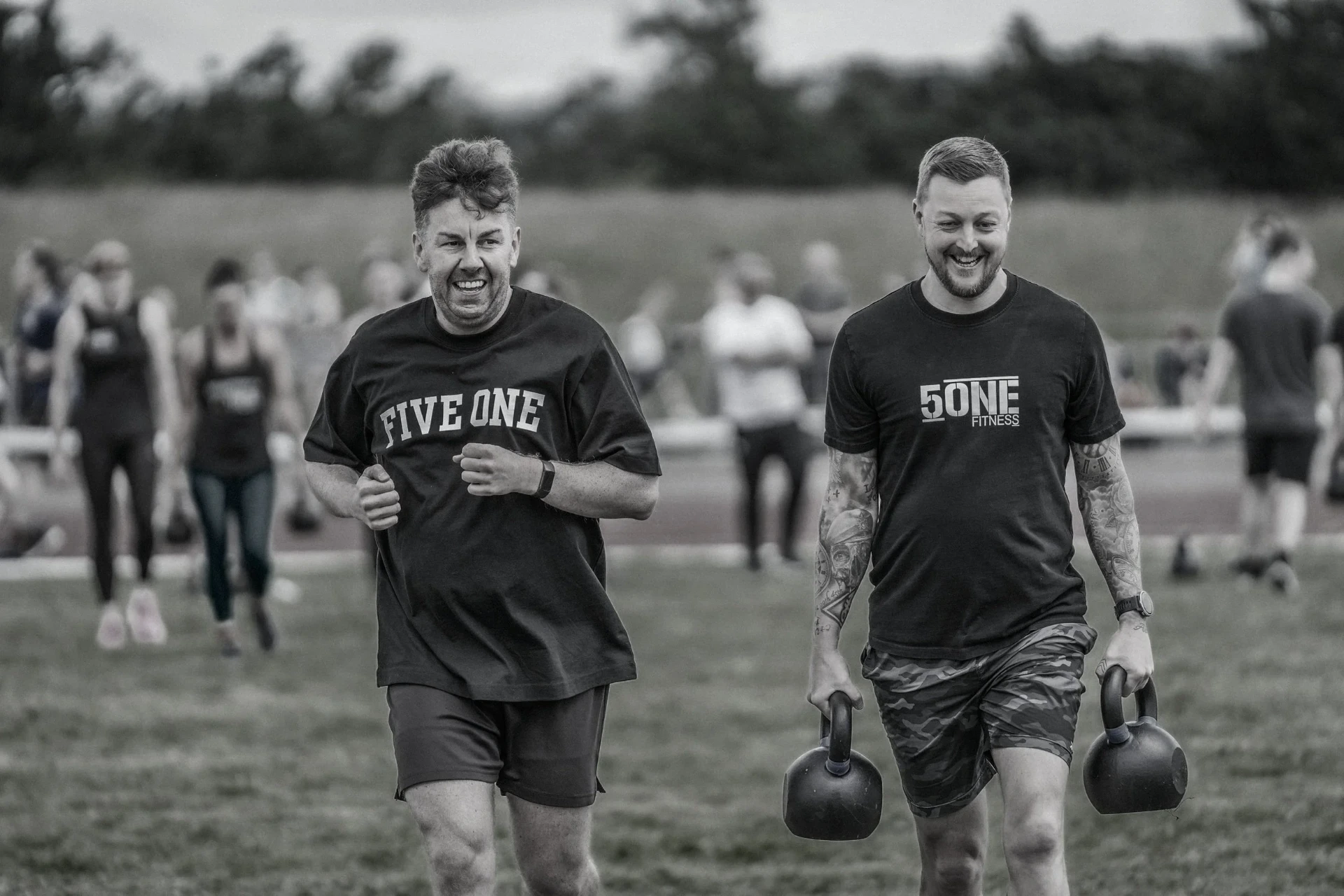
The principle is strength-endurance under fatigue with lots of transitions:
- 3× CrossFit classes: constantly varied free-weight and bodyweight work is exactly the stimulus you need.
- 1× run-to-labour session: repeat 400 m runs, each followed by a Labour (carry, snatch, goblet squat, devil press). This is the race in miniature.
- 1× carry and grip day: farmers carries, front carries, overhead carries, and kettlebell work. The race will find your grip.
- 1× interval run: 400 m repeats to sharpen pace and recovery between efforts.
This is close to what a normal week of CrossFit at CrossFit BC already looks like, just add dedicated run-to-labour and heavy-carry work in the 8 to 12 weeks before your event. Our 12-week Deadly Dozen plan lays out the full progression.
Cost, Logistics, and Where to Race
HYROX (Canada): $90 to $150 CAD per entry depending on category (Singles Open, Singles Pro, Doubles, Relay) and how early you register. Major events in Toronto and Vancouver each season.
Deadly Dozen: entry pricing varies by division and event. Check the official Deadly Dozen site for venues, dates, and registration. Vancouver 2026 runs on Sunday, July 19 at Dhillon Track, UBC.
Neither race is cheap, but compared to a marathon entry plus 16 weeks of dedicated run training, both are fair value for the experience.
Deadly Dozen Event Details (At a Glance)
- Distance: 4.8 km running (twelve 400 m runs), plus 12 Labours.
- Setting: track (Dhillon Track, UBC for Vancouver 2026).
- Categories: Solo, Pairs, and Relay. Divisions vary by event.
- Equipment: kettlebell, dumbbell, weight plate, and bodyweight only.
- Skill floor: if you can complete a regular CrossFit class without modifications, you can finish a Deadly Dozen, especially in Pairs or Relay.
Train at CrossFit BC: The Honest Pitch
We are a CrossFit + HYROX gym in Olympic Village, Vancouver. We coach athletes for both races out of the same room every week.
- Official equipment partner for HYROX-spec sleds, wall balls, and ski ergs, so you train on race-day gear.
- 3 dedicated HYROX SIM-ilar sessions per week built to mimic real race intensity and pacing.
- Coaches who race, not just program. They have stood on both start lines and can tell you what actually matters.
- Beginner-friendly: if "race" sounds intimidating, our 5-Day Foundations course gets you confident in the movements first. No experience required.
Easiest first step
Try us for free. Three classes, no commitment, see if the room and the coaching feel right.
Reader Promo Codes
A small thanks for reading the whole guide:
- HYROX Foundations: use code
HYROXREADYat checkout for $50 off your HYROX Foundations intake. - 30-Day Lifestyle Reset: use code
RESET30on the 30-Day Lifestyle Reset for an extra coaching call included. - Deadly Dozen entry: race partner codes are released a few weeks before each event. Join the gym or our newsletter and we will share the active code in the member email when it drops.
Codes are honored at our checkout only and may be updated, valid as of publishing.
The Bottom Line
HYROX is a global benchmark. It rewards preparation, consistency, and the discipline to execute a plan against a fixed, worldwide format.
Deadly Dozen is a run-heavy, free-weight team race. It rewards grip, carries, repeatable reps, and fast transitions across twelve rounds.
But the best race is the one you actually sign up for. Not bookmark. Not talk about at brunch. The one you commit to, train for, and show up to on race day.
Ready to commit?
- New to functional training? Start with 5-Day Foundations.
- Already active and want a structured kickstart? Try the 30-Day Lifestyle Reset.
- Have a HYROX race on the calendar? Jump straight into HYROX Race Ready.
- Just curious? Book 3 free classes and meet the team.
Want a coach to weigh in on which race fits you? Take the 2-minute Coaching Fit match and we will reply within 24 hours.
Frequently asked questions
Which race is harder, Deadly Dozen or HYROX?
Different kind of hard. HYROX rewards steady pacing across a fixed script. Deadly Dozen rewards raw grit across 12 varied labours. Most athletes find Deadly Dozen more brutal per minute.
Can I train for both in the same year?
Yes. Build a HYROX-style base year-round, then peak strength and grit in the 8 weeks before Deadly Dozen.
Which one is better for a first-time racer?
HYROX Doubles if you want a global, predictable format. Deadly Dozen if you want a Vancouver-first team event with more character.
Where do I sign up in Vancouver?
See our Deadly Dozen Canada hub and the HYROX Vancouver program.