
Personal Training vs Group Classes: Which One Actually Works for Busy Adults?
You've got limited time and budget. Should you invest in personal training or group fitness? Here's an honest comparison from a coaching team that offers both, and why the real answer might surprise you.
You know you need to start training consistently. You've probably tried a few things: a gym membership that collected dust, a running phase that lasted three weeks, maybe a fitness app that's still sending you notifications you ignore.
Now you're weighing your options. Personal training or group classes? Both have their advocates. Both can work. And both can fail spectacularly if the conditions aren't right.
We're a gym that offers both, so we have no reason to sell you one over the other. What we care about is what actually gets you results. Here's the honest breakdown.
The Real Question Isn't "Which Is Better." It's "Which Is Better for You Right Now."
Before we compare formats, let's reframe the question. The debate between personal training and group fitness assumes you have to pick one forever. You don't. Most of the people who get the best long-term results at CrossFit BC use some combination of both, and the right mix changes over time.
The question isn't which is objectively superior. It's which one matches where you are today: your goals, your experience level, your budget, your psychology, and your lifestyle. Let's break both down honestly so you can make the right call.
The Case for Personal Training
It's Built Entirely Around You
A personal trainer designs your program around your body, your goals, your limitations, and your schedule. Bad shoulder? They program around it. Training for a specific event? Everything points toward that goal. Only available at 6 AM on Tuesdays and Thursdays? Done.
At CrossFit BC in Olympic Village, Vancouver, every personal training client starts with a full assessment: DEXA body composition scan, movement screen, goal strategy session. Your program isn't pulled from a template. It's built from scratch, for you.
The Accountability Is Unavoidable
When you have a session booked at 6:30 AM with a coach who's expecting you, you show up. When it's just you and a gym membership, the snooze button wins. Your coach at CFBC knows if you missed a session. They'll check in. They'll adjust. They won't let you ghost your own goals.
Research published in the Journal of Sports Science and Medicine found that individuals who trained with a personal trainer attended 30% more sessions and achieved significantly greater improvements in strength compared to those who trained alone. The accountability mechanism alone is one of the most powerful drivers of consistency.
You Learn Faster
In a group class, a coach divides attention across 10-20 people. In a personal training session, every rep gets watched, every movement gets corrected, every question gets answered immediately. The learning curve is dramatically shorter.
This is especially important if you're learning complex movements like Olympic lifts, if you're working around injuries, or if you've never trained with barbells before. The density of coaching feedback per hour is simply higher in a 1-on-1 setting.
It's the Best Option for Specific Medical or Physical Considerations
If you're recovering from surgery, managing a chronic condition, working around significant mobility limitations, or dealing with a complex injury history, personal training gives your coach the bandwidth to adapt every rep in real time. Group classes can accommodate many limitations through scaling, but some situations genuinely require undivided attention.
The Drawbacks of Personal Training
Let's be honest about the limitations:
- Cost. Personal training costs more per session. In Vancouver, most studios charge $100-$180 per hour. At 3 sessions per week, that's $1,200-$2,160/month.
- Social isolation. If you thrive on energy from other people, solo training can feel flat. You miss the shared suffering, the collective encouragement, and the friendships that form when you train alongside others.
- Trainer dependency. If your trainer isn't developing your independence, you can end up unable to train effectively without them. Good coaching builds autonomy over time. Bad coaching creates dependency.
- Variety limitations. One trainer's programming reflects one trainer's knowledge. A coaching team at a facility like CrossFit BC draws on multiple coaches with different specialties, which broadens your training exposure.
The Case for Group Classes
The Energy Is Unmatched
There's a reason CrossFit, HYROX training, and group fitness have exploded globally. Training alongside other people creates an energy that solo training simply cannot replicate. When the whole room is grinding through the last two minutes of a workout, you find gears you didn't know you had.
A study published in the Journal of the American Osteopathic Association found that group fitness participants showed a 26% reduction in perceived stress and significant improvements in mental, physical, and emotional quality of life compared to solo exercisers. The social component isn't just nice to have. It's physiologically and psychologically powerful.
Community Creates Consistency
The social element of group classes is massively underrated for long-term adherence. At CrossFit BC, members don't just show up for the workout. They show up because their friends are there, because their coach expects them, because the Saturday crew grabs coffee afterward. That social glue keeps people training for years, not weeks.
Research from the Annals of Behavioral Medicine found that exercising with a partner or group increased workout duration by up to 200% compared to exercising alone. People don't quit communities the way they quit gym memberships.
It's More Affordable Per Coached Hour
Group class memberships cost a fraction of ongoing personal training. At CFBC, unlimited group classes start at $199/month for annual plans. That works out to 20+ coached sessions per month, each one programmed, coached, and progressive. A comparable frequency of personal training sessions would cost 6-10x more.
You Still Get Coached
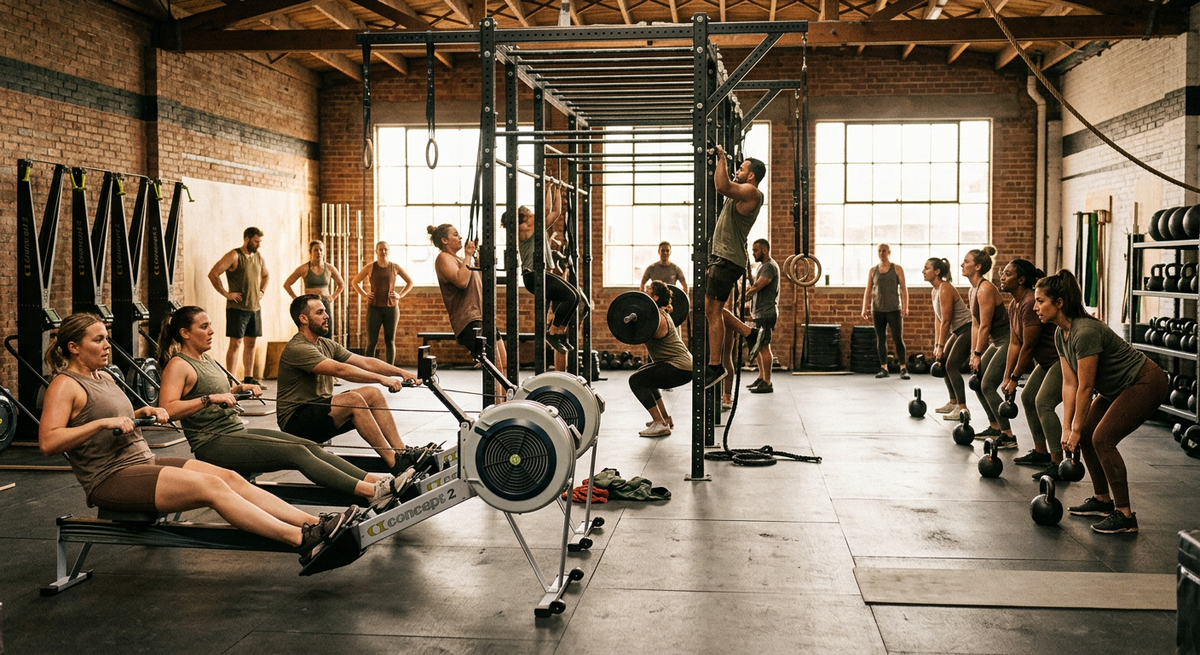
In a well-run group class (emphasis on "well-run"), you're still getting coaching. At CrossFit BC, our class sizes are intentionally capped so coaches can provide individual attention. Every member's workout is scaled to their ability, and coaches actively correct form throughout the session.
The key differentiator is coach-to-athlete ratio. A 30-person class at a big-box gym where one instructor shouts from a stage is not the same as a 12-person CrossFit class where a coach walks the floor and adjusts your movement in real time. Don't compare bad group fitness to good personal training. Compare the best of both.
Variety and Progressive Programming
In a well-programmed group setting, you get exposure to a much wider range of movements, modalities, and energy systems than most personal training clients ever see. CrossFit programming by design includes weightlifting, gymnastics, cardio, and functional movements in constantly varied combinations. That variety keeps you adapting and prevents the staleness that kills long-term compliance.
The Drawbacks of Group Classes
- Shared coaching attention. You're one of many. If you need significant form correction, a coach may not catch every rep.
- Programming serves the group. The workout is designed for the room, not for your specific goals. Scaling adapts intensity, but the movement selection and workout structure are universal.
- Initial intimidation. Walking into a group of people who already know each other and know the movements can feel daunting. This is real, and it's why good gyms have on-ramp programs like our Foundations course.
- Less individualization for complex needs. If you have significant injuries, post-surgical restrictions, or complex medical considerations, a group setting may not provide the level of attention you need initially.
The Science of Adherence: What Actually Keeps People Training
Here's what the research says about why people stay consistent with exercise over the long term:
- Social support is the #1 predictor of exercise adherence in meta-analyses spanning decades of research. People who train with others stick with it longer.
- Coaching relationships significantly improve both adherence and outcomes. A coach who knows your name, your history, and your goals creates a relational bond that a gym keycard never will.
- Structured scheduling (fixed class times, booked sessions) dramatically outperforms unstructured access. Decision fatigue is real: the fewer choices you have to make, the more likely you are to act.
- Progressive challenge keeps people engaged. Plateaus and boredom are consistency killers. Both PT and group classes can provide progression, but the mechanism differs.
- Enjoyment matters more than most people acknowledge. If you hate your training, you'll stop. Period. No amount of discipline overrides sustained misery.
The best training format for you is the one that maximizes these adherence factors given your personality, your lifestyle, and your current fitness level.
The Real Answer: It Depends on Where You Are
Here's what our coaching team has seen over 17+ years of training people in Vancouver:
Choose Personal Training If:
- You're brand new to fitness and want to build a foundation before joining group classes
- You have specific injuries or limitations that need individual attention
- You have a performance goal (a HYROX race, a weightlifting competition) that needs customized programming
- You struggle with consistency and need maximum accountability
- You learn better with undivided coaching attention
- You're post-surgical or managing a medical condition that requires careful exercise prescription
- You're an experienced athlete who needs highly specific programming to break through plateaus
Choose Group Classes If:
- You're motivated by social energy and community
- You want variety in your training without having to plan it yourself
- You're reasonably comfortable with basic movement patterns (or willing to learn through a Foundations program)
- You want the most training value per dollar
- You're looking for a long-term fitness home, not a short-term fix
- You tend to push harder when others are around
- You enjoy the structure of a set schedule rather than having to plan each session
The Best Option: Both
Here's what we've found works best for most busy adults: start with personal training to build your foundation, then transition into group classes for the long term, with periodic PT sessions to refine technique or break through plateaus.
This is exactly why we designed the 30-Day Lifestyle Reset. It combines 8 personal training sessions with up to 12 group classes, plus a DEXA scan, nutrition coaching, and daily accountability. You get the best of both worlds in a single program, and you build the skills and confidence to continue with group training long after the 30 days are done.
The Hybrid Model: How Smart Athletes Use Both
At CrossFit BC, our most successful long-term members typically settle into a hybrid approach. It looks something like this:
Phase 1: Foundation (Months 1-3)
Start with the 30-Day Lifestyle Reset or personal training to learn movement patterns, build confidence, and establish a baseline. During this phase, your coach is teaching you the language of training: how to squat, how to hinge, how to press, how to pull. You're also learning how to read a workout, how to scale intelligently, and how to pace yourself.
Phase 2: Integration (Months 3-12)
Transition primarily to group classes (3-5 per week), supplemented by 1-2 personal training sessions per month for technique refinement. This is where community takes over as your primary accountability mechanism. You've built relationships. You have a crew. The training is fun, not just productive.
Phase 3: Optimization (Year 2+)
Fully integrated into the group training community. Periodic personal training blocks (4-8 sessions) when you want to focus on a specific skill, prepare for a competition, or address a new goal. You might also layer in specialty classes: Olympic Weightlifting, Gymnastics Skills, HYROX training, or Mobility.
This progression from high coaching density to community-driven training is the most effective long-term model we've seen. It builds competence, confidence, and belonging in the right order.
What to Look for in a Personal Trainer
Not all personal trainers are equal. Here's what separates great coaching from expensive rep-counting:
- Proper assessment before programming: If a trainer writes your program before assessing your movement, walk away
- Real certifications: Look for credentials backed by substantial education (CF-L2+, CSCS, NSCA), not weekend certifications
- Floor experience: How many years have they actually coached? Do they train alongside their clients?
- Nutrition guidance: Training and nutrition go together. A good coach addresses both
- Progress tracking: Your coach should be tracking your numbers, your movement quality, and your progress systematically
- Team environment: At CFBC, you're not getting one trainer. You're getting an entire coaching team with different specialties who collaborate on your programming
- They build your autonomy: The goal of great coaching is to make you more capable and independent over time, not more dependent on your trainer
What to Look for in a Group Fitness Gym
- Class sizes: Smaller is better. If there are 30 people per class, you're not getting coached
- Coaching quality: Are coaches actively correcting form, or just running a timer?
- Scaling options: Does every workout have scaled versions for different ability levels?
- Programming variety: Is the programming varied and progressive, or the same thing every week?
- Community culture: Do members know each other's names? Do people stick around after class?
- Longevity: How long has the gym been operating? A gym that's been around 17+ years (like CrossFit BC) has proven its model works
- On-ramp program: Does the gym have a structured way to bring in beginners? If they throw you into a regular class on day one, that's a red flag
- Coach-to-athlete ratio: Ask specifically how many people are in each class and how many coaches are on the floor
The Cost Comparison (Real Vancouver Numbers)
Let's put real numbers on it for Vancouver in 2026:
Personal Training (Most Vancouver Studios)
- $100-$180 per session (60 minutes)
- At 3 sessions per week: $1,200-$2,160/month
- Annual cost: $14,400-$25,920
- Coached hours per month: 12
- Cost per coached hour: $100-$180
Group CrossFit Membership (CFBC)
- $199-$259/month for unlimited classes
- At 4 classes per week: 16-20+ coached sessions per month
- Annual cost: $2,388-$3,108
- Coached hours per month: 16-20+
- Cost per coached hour: ~$10-$16
30-Day Lifestyle Reset (CFBC)
- $999 one-time for 8 PT sessions + 12 group classes + DEXA scan + nutrition coaching + daily accountability
- Coached hours included: ~20
- Cost per coached hour: ~$50 (combining both formats)
Per coached hour, group classes are hard to beat. But the personalized attention of PT is worth the investment for specific goals, injuries, or building your initial foundation. The 30-Day Lifestyle Reset bridges both at a fraction of the standalone cost.
Common Mistakes People Make When Choosing
Mistake 1: Choosing Based on Price Alone
The cheapest option that doesn't work is infinitely more expensive than the pricier option that does. If a $30/month gym membership sits unused for a year, you've spent $360 on guilt. If a $259/month membership keeps you training 4x/week for a year, you've invested in your health at ~$5 per session.
Mistake 2: Assuming Personal Training Is Always Better
It's not. If you're self-motivated, enjoy social training, and have solid movement fundamentals, group classes may be more effective for you than personal training. The best format is the one you'll actually stick with.
Mistake 3: Ignoring the Community Factor
People dramatically underweight the importance of social connection in fitness. The gym where your friends train is the gym you'll keep going to. Choose community first, format second.
Mistake 4: Not Starting Because You Can't Decide
Analysis paralysis kills more fitness goals than bad programming ever will. Pick one format, start, and adjust. You can always change your approach. You can't get back the months you spent overthinking it.
How CrossFit BC Combines Both
At our 278 East 1st Avenue, Olympic Village location, we offer personal training and group classes under the same roof, with the same coaching team. That means:
- Your PT coach and your group class coach communicate about your programming
- You can transition seamlessly between PT and group sessions
- Your progress is tracked consistently across both settings
- You get community and individual attention without choosing one or the other
- The coaching team covers multiple specialties: CrossFit, HYROX, Olympic weightlifting, gymnastics, mobility, and more
Most of our long-term members use a combination. A few PT sessions per month for technique work, plus unlimited group classes for the energy, variety, and community.
We'd Love to Hear From You
Not sure which is right for you? That's exactly what our coaching team is here for. Try 3 classes free to experience our group training. Or explore the 30-Day Lifestyle Reset to get both personal training and group classes in one structured program.
No commitment until we've had a conversation. We're at 278 East 1st Avenue, Olympic Village, Vancouver.