
Longevity Without Vitality Is a Goal Not Worth Pursuing (and Here's Why)
Living longer is not the win everyone thinks it is, not if your strength, purpose, energy, and joy disappear on the way there. This is the case for vitality over lifespan, and how to build a life that stays strong, meaningful, and connected for decades.
Longevity is not the goal if your strength, purpose, and joy disappear on the way there.
This is really a question of healthspan, not lifespan. Start with what healthspan actually is and how to prioritize it.
Read that again. Because the entire health and wellness industry is increasingly obsessed with one number: how long you live. And almost nobody is asking the question that actually matters.
What kind of life are you extending?
Are you adding years of energy, capability, connection, and purpose? Or are you adding years of decline, dependence, disconnection, and diminished quality?
Because those are two very different outcomes. And the path to each one looks nothing alike.
The Problem With Modern Longevity Culture
Somewhere along the way, the longevity conversation got hijacked.
It became about optimization protocols, supplement stacks, cold plunges, red light therapy, NAD+ drips, peptide injections, and an endless parade of interventions designed to extend the biological clock.
None of those things are inherently wrong. Some have real science behind them. But they've created a culture that worships the number of years while ignoring the quality of those years.
Here's what that looks like in practice:
- People obsessing over biomarkers while their relationships deteriorate
- People spending thousands on anti-aging protocols while their strength declines because they never train
- People tracking every metric but unable to play on the floor with their kids or carry groceries up three flights of stairs without getting winded
- People living longer but lonelier, more anxious, and less capable than previous generations
The World Health Organization has been clear on this: the goal should be "adding life to years, not just years to life." But the industry hasn't caught up. The incentives still favor selling the promise of more time, not better time.
What Vitality Actually Means
Vitality isn't a buzzword. It's the measurable, felt experience of being alive and capable.
Here's what vitality looks like in practice:
- Strength: The ability to lift, carry, push, pull, and support your own body and the things you care about
- Mobility: Moving freely through full ranges of motion without pain, restriction, or fear
- Energy: Waking up with enough fuel to pursue what matters, not just enough to survive the day
- Recovery: Bouncing back from physical and emotional stress without prolonged breakdown
- Capability: Being able to do the things your life requires and the things that bring you joy, whether that's hiking, playing with grandchildren, traveling, or training
- Curiosity: An active interest in learning, growing, and experiencing new things
- Purpose: A clear reason to get up in the morning that goes beyond obligation
- Joy: Genuine pleasure in daily life, not just the absence of suffering
- Adaptability: The resilience to handle what life throws at you, physically and emotionally
- Connection: Meaningful relationships that provide support, accountability, and belonging
That's vitality. And none of it is measured by how many candles are on your birthday cake.
Lifespan vs. Healthspan vs. Vitality
These three concepts are related but critically different:
Lifespan is simply how long you live. It's the number. It tells you nothing about quality.
Healthspan is the period of your life spent in good health, free from chronic disease and significant disability. It's a better metric than lifespan alone, and it's increasingly used in longevity research as the more meaningful target.
Vitality is what makes healthspan worth having. You can be technically "healthy" (no diagnosed diseases, normal bloodwork) and still feel flat, disconnected, weak, purposeless, and disengaged. Vitality is the difference between surviving and thriving.
Here's the hierarchy that matters: Vitality > Healthspan > Lifespan.
If you have vitality, healthspan follows. If you have healthspan, lifespan often takes care of itself. But chasing lifespan alone, without building vitality, is like painting a house with a crumbling foundation. It looks fine from the outside. It doesn't hold up when the storms come.
The Cost of Chasing Longevity Without Vitality
What does it actually look like when someone lives a long life without vitality? It's not hypothetical. We see it every day.
Physical decline without support. Muscle mass drops 3-8% per decade after 30 without resistance training. Bone density decreases. Balance deteriorates. Falls become dangerous. Activities that were once effortless become impossible. And the decline accelerates if nothing is done to counteract it.
Emotional flatness. Without purpose, challenge, and connection, many people experience a slow erosion of engagement with life. Not clinical depression necessarily, but a persistent "what's the point?" that colors everything.
Disconnection. Social circles shrink with age, especially without intentional effort. Retirement removes the built-in social structure of work. Friends move, get sick, or pass away. Without new sources of connection, isolation becomes the default.
Loss of capability. The inability to do the things that give life meaning. Can't travel because the body can't handle it. Can't play with grandchildren because the knees give out. Can't pursue hobbies because the energy isn't there. Can't live independently because the strength isn't sufficient.
Extended decline. Modern medicine is excellent at keeping people alive. It's less excellent at keeping people vital. The result, for many, is additional years spent in a state of diminished capacity that no one would choose if they saw it clearly in advance.
This isn't fear-mongering. It's reality. And it's largely preventable with the right inputs, started early and sustained consistently.
What Actually Supports Vitality Over the Long Term
The research on what builds and sustains vitality is remarkably consistent. It's not exotic. It's not expensive. But it requires consistency and intention.
Strength Training
Resistance training is the single most important physical intervention for long-term vitality. It preserves muscle mass, bone density, metabolic health, hormonal function, and functional independence. A 2022 meta-analysis in the British Journal of Sports Medicine found that muscle-strengthening activities were associated with a 10-17% lower risk of all-cause mortality, cardiovascular disease, cancer, and diabetes.
This isn't optional. It's foundational. And it needs to start now, regardless of your age, and continue for the rest of your life. Programs like CrossFit classes, personal training, and Living Legends (for adults 60+) are built on this principle.
Movement Variety
Strength alone isn't enough. Your body needs varied movement: cardiovascular conditioning, flexibility work, balance training, and coordination challenges. The body adapts to what you ask of it. Ask it to do diverse things, and it stays capable of diverse things.
Mobility and Resilience
Joint health, range of motion, and the ability to recover from physical stress are non-negotiable for long-term vitality. Stiff, immobile bodies break down. Mobile, resilient bodies adapt and endure.
Sleep and Recovery
Sleep is when your body repairs, consolidates memory, regulates hormones, and clears metabolic waste from the brain. Chronic sleep deprivation is associated with accelerated cognitive decline, increased inflammation, impaired immune function, and elevated risk of every major chronic disease. 7-9 hours of quality sleep is not a luxury. It's a biological requirement.
Purposeful Challenge
Human beings need challenge to thrive. Not crushing, unsustainable challenge. But meaningful, progressive challenge that creates growth. Training for a goal. Learning a new skill. Pursuing something that matters. Without challenge, the body and mind both atrophy.
Meaningful Relationships
The Harvard Study of Adult Development, one of the longest-running studies of human health in history, found that the quality of your relationships is the single strongest predictor of health and happiness across the lifespan. Not wealth. Not fame. Not genetics. Relationships.
Belonging and Accountability
Having a community, a group of people who expect you, support you, challenge you, and celebrate with you, changes adherence to every healthy behavior. You exercise more when others are counting on you. You eat better when your community reinforces it. You show up on hard days because someone notices when you don't.
A Reason to Keep Showing Up
Purpose isn't just a feel-good concept. A 2019 study in JAMA Network Open found that people with a strong sense of purpose had significantly lower rates of all-cause mortality, even after controlling for other health factors. Purpose protects you. It gives your biology a reason to keep investing in maintenance and repair.
Aging With Purpose
The phrase "aging gracefully" has always bothered us at CrossFit BC. It implies passivity. Acceptance of decline. Gentle surrender.
We prefer "aging with purpose."
That means staying strong enough to be useful. Mobile enough to be active. Energized enough to be present. Connected enough to be supported. And purposeful enough to keep contributing.
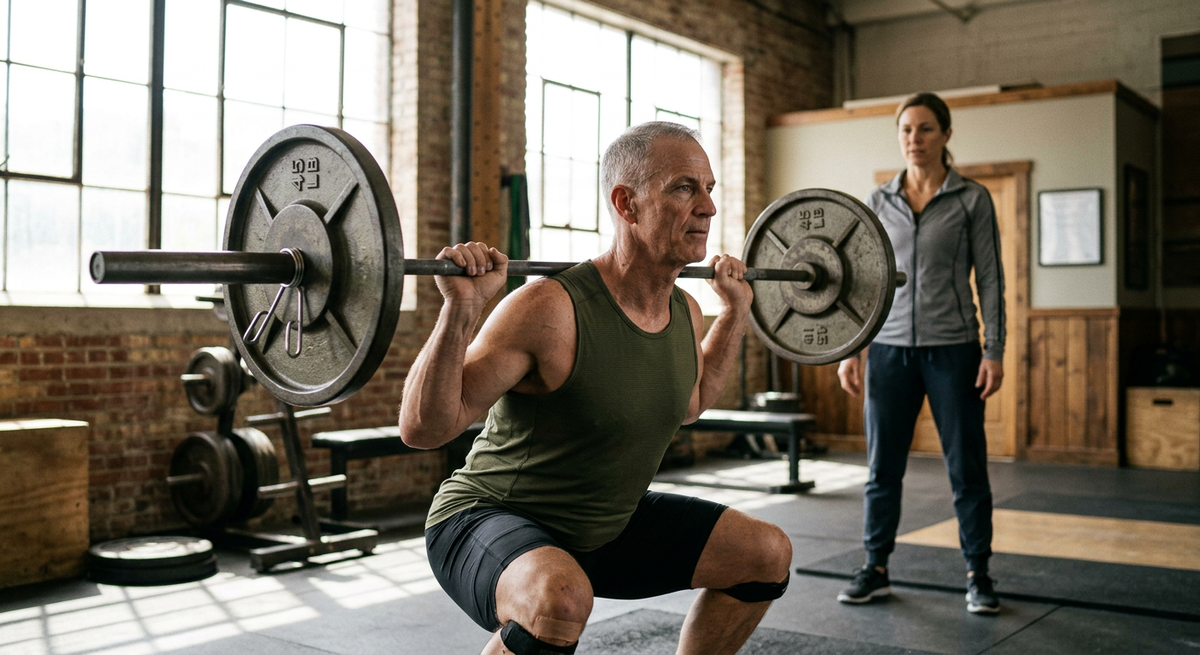
It means a 65-year-old who deadlifts, plays with grandchildren, hikes with friends, and mentors younger athletes. It means a 55-year-old who's in the best shape of their life because they finally found a training environment that works. It means a 70-year-old who shows up to class three times a week because the community matters as much as the workout.
Aging with purpose isn't about denying aging. It's about refusing to let aging become an excuse to stop building, growing, contributing, and showing up.
Why Community Is Part of Vitality
You can have perfect biomarkers, optimal nutrition, and a flawless training program. But if you're doing it all alone, something essential is missing.
Isolation is one of the strongest risk factors for early mortality. The research is unambiguous: socially isolated individuals have a 26% higher risk of premature death. Loneliness is as harmful as smoking 15 cigarettes a day. And it's increasing in every age group across Western nations.
Community isn't a nice-to-have. It's a biological need.
Shared physical challenge creates a unique kind of bond. When you struggle together, celebrate together, and show up for each other consistently, you build something that no supplement or protocol can replicate: genuine human connection anchored in shared purpose.
That's why we believe so strongly in the community model at CrossFit BC. Training together changes people in ways that training alone never can. The Hybrid Membership exists because some people need both the personal attention of 1-on-1 coaching and the energy of group training. Our 30-Day Lifestyle Reset works because it wraps structure, coaching, and community support around a critical transition period.
How CrossFit BC Sees This
We didn't build CrossFit BC to help people live longer. We built it to help people live better.
That means:
- Train for life. Not for a competition (unless you want to). Not for aesthetics alone. For the ability to live your life fully and capably for as long as possible.
- Move well. Quality of movement matters more than quantity. A body that moves well is a body that lasts.
- Get stronger. Strength is the foundation of everything: independence, resilience, confidence, capability. Our coaches build programs that develop strength progressively and safely at every age.
- Stay capable. The goal is to be able to do the things your life requires and the things that bring you joy, today and in 30 years.
- Support one another. We're better together. That's not a slogan. It's the research, and it's our experience every day on the coaching floor.
- All ages and stages. A 25-year-old training for their first HYROX race and a 65-year-old building bone density in Living Legends are equally important, equally supported, and equally part of this community.
- Leave better than you arrived. Every class. Every program. Every interaction. That's the standard.
Ready to start building vitality, not just years? Our 60-Second Program Quiz helps you find the right starting point based on where you are right now.
Try 3 Classes Free and experience what training for life actually feels like.
The Real Goal
A long life without vitality is not the win most people think it is.
Living to 90 with 20 years of declining capability, increasing isolation, and diminished purpose isn't longevity worth celebrating. It's a cautionary tale.
The real goal is to build a life that stays strong, meaningful, connected, and alive for as long as possible. To add life to your years, not just years to your life.
That means strength training, today and every decade that follows. That means investing in relationships, community, and belonging with the same seriousness you invest in your portfolio. That means finding purpose and pursuing it actively, not waiting for retirement to figure out what matters.
It means choosing vitality. Every day. On purpose.
Because the people who age best aren't the ones with the most supplements or the lowest biological age score. They're the ones who are strong, connected, purposeful, and still building something that matters.
That's the kind of aging we believe in at CrossFit BC. And that's what we help people build, one training session, one coaching conversation, and one community connection at a time.
One practical note, because peptide injections came up earlier and the question always follows: if you have already decided to try them, sourcing is the part that hurts people. Read the cautions before the link.