
The 9 Essential CrossFit Movements (And Why We Teach Them First)
CrossFit is built on 9 foundational movements. Not 90. Not 900. Nine.
These movements are the alphabet of human performance. Every workout you'll ever see on a CrossFit whiteboard is a sentence written with these letters. Master them, and you can do anything. Skip them, and everything downstream breaks.
This is why our Foundations program exists. Not to gatekeep. To give you the foundation that makes everything else possible.
"Performing the common uncommonly well." - CrossFit Training & Education
Why Only 9 Movements?
Because these 9 patterns cover the full range of what a human body needs to do: squat, press, pull, hinge, and move load from ground to overhead. They progress logically. Each one builds on the last. And together, they prepare you for every variation you'll encounter in CrossFit.
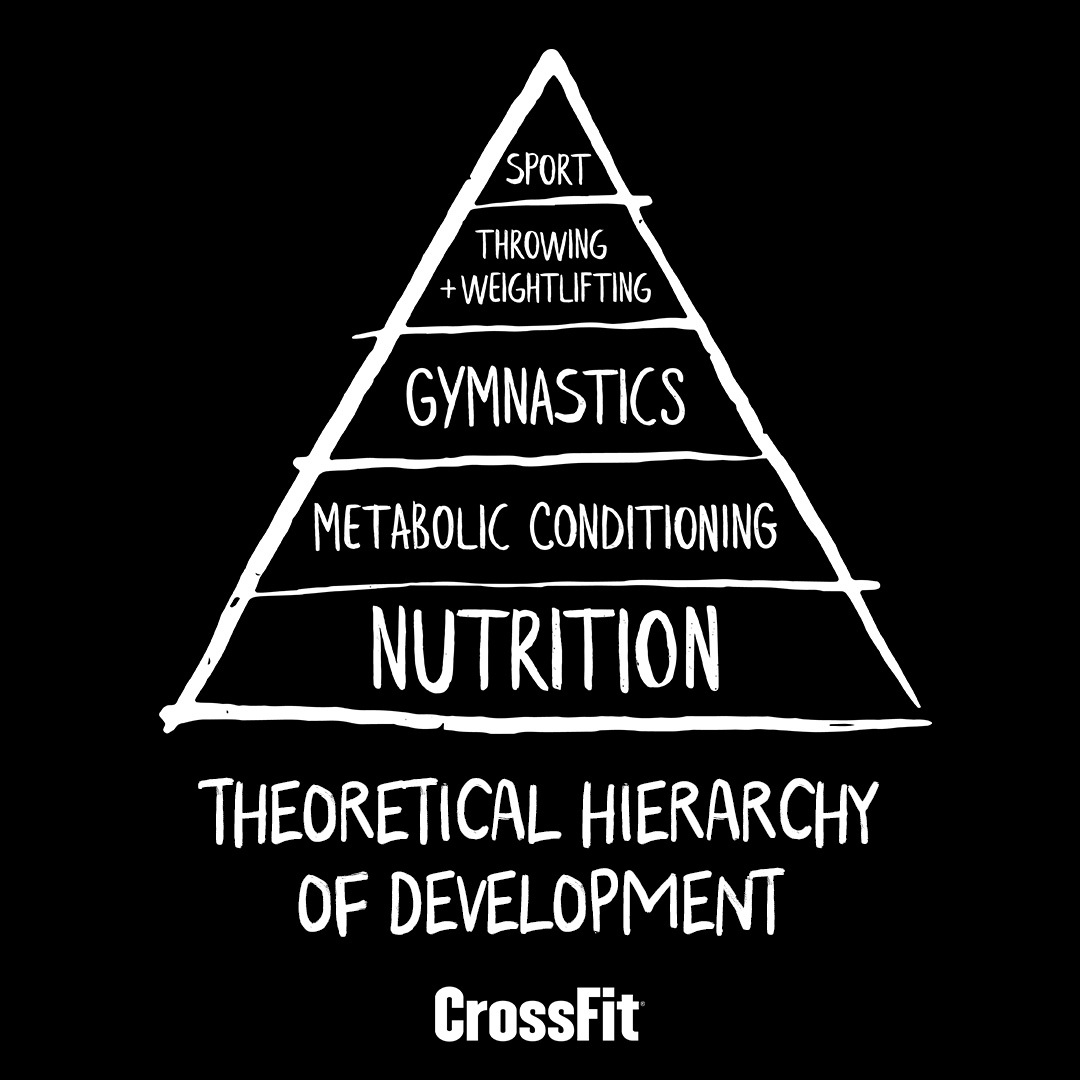
As we explored in The Theoretical Hierarchy of Development, movement sits at the foundation of CrossFit's pyramid. These 9 movements are the bedrock of that foundation.
And as Differ by Degree, Not Kind teaches us, these same 9 movements apply to everyone. The Olympic athlete and the grandparent learning to squat for the first time are performing the same patterns. Only the load changes.
The Squatting Family
1. Air Squat
The cornerstone. Every squatting movement in CrossFit begins here. The air squat raises your center of mass from a seated to standing position using nothing but your own body.
Key points of performance:
- Shoulder-width stance
- Hips descend back and down, below the knees
- Lumbar curve maintained throughout
- Heels stay down
- Knees track in line with toes
- Complete at full hip and knee extension
This is the movement your coach will return to again and again. It teaches midline stability, hip mechanics, and the bottom position that transfers to everything from front squats to wall balls to thrusters.
2. Front Squat
Same squat, new demand. Now the barbell sits across the front of your torso. Everything from the air squat carries over, plus a new challenge: keeping those elbows high while maintaining an upright torso under load.
What's new:
- Hands just outside of shoulders with a loose, fingertip grip
- Elbows high - this is the number one coaching cue you'll hear
- Bar moves in a straight path over the middle of the foot
The front squat builds the front-rack position used in cleans, thrusters, and wall balls. It's also a demanding core exercise disguised as a leg movement.
3. Overhead Squat
The most demanding of the three squat variations. A load is balanced overhead while you descend into a full-depth squat. It demands mobility through the thoracic spine, shoulders, hips, and ankles all at once.
What's new:
- Wide grip on the bar
- Shoulders actively pushing up into the bar
- Armpits face forward
- Bar moves over the middle of the foot throughout
The overhead squat is both a diagnostic tool and a training tool. If something is tight, weak, or uncoordinated, the overhead squat will expose it. That makes it the single best movement assessment in CrossFit. It is also the receiving position for the snatch, CrossFit's most technically demanding lift.
The Pressing Family
4. Shoulder Press (Strict Press)
The foundation for all overhead work. Pure upper-body pressing strength with zero help from the hips or legs. The torso stays rigid, the bar moves in a straight path, and the arms drive the load to lockout.
Key points of performance:
- Hip-width stance
- Elbows slightly in front of the bar
- Full grip on the bar
- Torso and legs completely static
- Bar moves over the middle of the foot
- Complete at full arm extension with shoulders pushing into the bar
5. Push Press
Same setup as the shoulder press, but now the hips and legs contribute. A vertical dip and explosive drive of the torso add velocity to the barbell. This is where you learn the power of hip drive.
What's new:
- Torso dips straight down (not forward)
- Hips and legs extend first, then the arms press
- Heels stay down until the hips and legs fully extend
The push press teaches an essential CrossFit concept: the hip is the engine. You'll use this pattern in push jerks, thrusters, wall balls, and every time you need to move load overhead efficiently.
6. Push Jerk
The most advanced of the pressing family. After the dip and drive, the athlete presses under the bar and receives it in a partial overhead squat before standing to finish.
What's new:
- After the hip reaches full extension, you press yourself under the bar
- Receive the load in a partial overhead squat position
- Stand to full extension to complete the lift
The push jerk brings the squat and press families together. It demands coordination, timing, and the ability to move your body around the bar rather than the bar around your body. This is the pattern used in the split jerk for competitive Olympic weightlifting.
The Pulling Family
7. Deadlift
The most fundamental pulling movement. Raise a load from the ground to a standing position by hinging at the hips while maintaining a neutral spine. Simple concept, profound importance.
Key points of performance:
- Hip-width stance
- Hands just outside of hips with a full grip
- Shoulders slightly in front of the bar at setup
- Hips and shoulders rise at the same rate
- Lumbar curve maintained throughout
- Bar moves over the middle of the foot
- Complete at full hip and knee extension
The deadlift is foundational to every pulling movement in CrossFit. The neutral spine position learned here carries directly into cleans, snatches, kettlebell swings, and rowing.
8. Sumo Deadlift High Pull (SDHP)
A wider stance, narrower grip, and the addition of velocity and range of motion. The SDHP is a textbook core-to-extremity movement: power is generated by the hips and legs, then handed off to the upper body.
What's new:
- Slightly wider than shoulder-width stance
- Hands inside legs with a full grip
- After the hips extend, shoulders shrug, then arms pull
- Elbows move high and outside
- Complete with bar pulled under the chin at full hip/knee extension
This movement teaches the power transfer sequence (hips, then shrug, then arms) that is the foundation of every Olympic lift.
9. Medicine-Ball Clean
The clean is where it all comes together. The med-ball clean builds on the deadlift and SDHP and adds the pull under: the ability to bring an object from the ground to a front-rack position by pulling yourself under the load.
What's new:
- Ball between the feet, palms on the ball
- Hips extend rapidly, then shoulders shrug
- Arms pull under to the bottom of a squat
- Receive the ball in the front-rack position at the bottom
- Stand to full hip and knee extension
We teach this with a medicine ball first because it's forgiving, tactile, and forces you to receive the load properly. Once you own this pattern, transitioning to a barbell clean is a natural next step.
The Supporting Cast: Hip Extension, Back Extension & GHD Sit-Up
Beyond the 9 core movements, CrossFit's Essential Movements flipbook also covers three supplementary exercises that build the muscular control and midline stability required for everything above:
- Hip Extension: Builds glute and hamstring control while maintaining a static trunk position. Teaches the hip hinge in isolation.
- Back Extension: Develops the spinal erectors' ability to recover from a flexed spine position. Teaches segmental control of the spine.
- GHD Sit-Up: Challenges the athlete to stabilize the spine during dynamic movement. Demands hip flexor and abdominal control through a full range of motion.
These movements don't make the highlight reel, but they build the engine that powers everything else.
How Our Foundations Program Teaches These Movements
At CrossFit BC's Foundations program, we teach all 9 movements one-on-one with a senior coach across a structured curriculum:
| Session | Focus | Movements Covered |
|---|---|---|
| Day 1 | Foundations & Lower Body | Air Squat, Front Squat, Overhead Squat |
| Day 2 | Pressing & Pulling | Shoulder Press, Push Press, Push Jerk, Deadlift |
| Day 3 | Integration & Simulation | SDHP, Med Ball Clean, Full Assessment WOD |
Each session builds on the last. By Day 3, you're not just learning movements in isolation. You're performing them in a real workout context, with coaching, scaling, and feedback in real time.
Why This Matters for You
Whether you're 25 or 65, a competitive athlete or someone who just wants to move from sickness toward wellness toward fitness, these 9 movements are your starting point.
They teach you how to:
- Squat safely and effectively (sit down, stand up, pick things up)
- Press loads overhead using your whole body (put things on shelves, carry kids)
- Pull loads from the ground with a protected spine (pick up groceries, move furniture)
- Transfer power from your hips through your extremities (every sport, every activity)
As Nicole Carroll, CrossFit's Chief Brand Officer, wrote in the Essential Movements guide: "CrossFit trainers model and impart CrossFit's culture of excellence, service, and community. The coach is the final and most critical component in passing on the magic of CrossFit."
That's what Foundations is about. Not just learning 9 movements. Learning them from a coach who cares about your long-term success and meeting you exactly where you are.
Ready to learn these movements?
Our Foundations program teaches all 9 essential movements one-on-one with a senior coach. No experience necessary.
Start Foundations Try 3 Free ClassesFurther Reading
- The Theoretical Hierarchy of Development - Why nutrition sits at the base and sport at the top
- By Degree, Not Kind - How these same movements scale to every human
- The Sickness-Wellness-Fitness Continuum - Where movement fits in your health journey
- CrossFit for Beginners - Everything you need to know before your first class
- Eat Real Food - The nutrition philosophy that supports your training