Do I Need to Be Fit Before Joining CrossFit? (Honest Answer from Coaches)
The most common reason people don't start CrossFit is because they think they're not ready. Here's why that thinking is backwards, and what your first month actually looks like.
We hear it every week. In emails, in DMs, in conversations at coffee shops in Olympic Village: "I want to try CrossFit, but I need to get in shape first."
We get why people say it. And it makes sense on the surface. But after 17+ years of coaching, we can tell you with absolute certainty: it's completely backwards.
You don't get fit to start CrossFit. You start CrossFit to get fit. That's literally the whole point. And at CrossFit BC in Olympic Village, Vancouver, our coaching team has helped thousands of people begin from exactly where they are, not from where they think they should be. Some of our strongest, most committed members walked in the first time convinced they didn't belong. Now they're the ones welcoming new faces.
This article is going to dismantle this myth piece by piece. We'll show you why the "I'm not ready" thinking is so common, why it's wrong, what actually happens when beginners start, and how the science of exercise adaptation works in your favor from day one.
Why People Think They Need to "Get Ready" First
It makes sense on the surface. You see CrossFit videos online and the athletes look superhuman. You imagine walking into a gym full of ripped people doing impossible things, and you standing there unable to do a single push-up.
But that's not reality. That's a highlight reel.
The truth is, every single person in those videos started somewhere. Many of them started exactly where you are right now. Out of shape. Nervous. Unsure if they belonged. And they showed up anyway.
The Psychology of Delay
The "I need to get ready first" mindset is a form of what psychologists call self-handicapping: creating conditions that justify not taking action. It feels productive because you're "preparing," but it's actually avoidance dressed up as planning.
Here's the pattern: "I'll start running first, then join CrossFit." So you run for two weeks. Then you stop. Then you feel worse about being out of shape. Then the bar for "ready" gets even higher. Months pass. Sometimes years. We've had members tell us they waited three years before walking through the door. Three years of "getting ready" that never happened. The readiness you're waiting for never arrives because it can't. Readiness comes from doing, not from waiting.
The Comparison Trap
Social media makes this worse. When every CrossFit post features elite athletes doing muscle-ups and heavy snatches, it creates a distorted picture of what a CrossFit class actually looks like. The reality? Most members at CrossFit BC will never compete in the CrossFit Games. They're parents, professionals, retirees, students, and busy adults who want to feel strong, healthy, and capable. They look like normal people. Because they are normal people.
The Science of Why Starting "Unfit" Actually Works in Your Favor
Here's something most people don't know, and it's genuinely exciting: the less fit you are when you start, the faster you improve. Exercise science calls this the "beginner effect" or "newbie gains," and it's well-documented. Your starting point isn't a disadvantage. It's actually your superpower.
The Principle of Initial Adaptations
When you expose your body to a new stimulus (like resistance training or functional movement), it responds aggressively. Neurological adaptations happen first: your brain gets better at recruiting muscle fibers, your coordination improves, and your movement efficiency increases. This happens within the first 4-8 weeks.
Then structural adaptations follow: muscle tissue grows, connective tissue strengthens, bone density increases, and metabolic pathways become more efficient. For someone who hasn't trained before, these adaptations are dramatic and rapid.
Research on Beginner Adaptation Rates
A study published in the European Journal of Applied Physiology found that untrained individuals can increase their strength by 25-100% within the first 3-6 months of a structured resistance training program. By contrast, advanced athletes might gain 1-5% per year. Your starting point isn't a disadvantage. It's your biggest advantage.
The "Minimum Effective Dose" Works for Beginners
You don't need to train 6 days a week to see results when you're starting out. Research consistently shows that beginners see significant improvements with just 2-3 training sessions per week. At CrossFit BC, we recommend most beginners start with 3 classes per week and build from there. The response you get from those sessions is enormous compared to what an advanced athlete gets from the same volume.
What Actually Makes a Gym "Beginner-Friendly"
Not every gym handles beginners well. A gym calling itself beginner-friendly and actually being beginner-friendly are two different things. Here's what separates the real ones from the marketing ones:
A Structured On-Ramp
At CrossFit BC, every new member goes through our Foundations program. This isn't just an introductory class you sit through. It's a structured course that teaches you every core movement, builds your confidence, and prepares you to join regular classes safely. You learn before you're asked to perform.
Not every CrossFit gym has a Foundations program. Some throw you into a regular class on day one. That approach works for some people, but it leaves many feeling overwhelmed and lost. A structured on-ramp exists because beginners deserve to learn properly, not just survive.
Coaches Who Assess Before They Program
Your first interaction with our coaching team isn't a sales pitch. It's a conversation about your goals, your history, your body, and any limitations you're working with. We screen your movement before we program your workouts. That's how it should be done.
Scaling That's Built Into Every Workout
Every workout at CFBC has multiple scaled options. Can't do a pull-up? There's a version for you. Can't squat below parallel? There's a modification. Can't run 400 metres? We'll substitute. Scaling isn't a lesser version of the workout. It's the smart version, and it's how every experienced athlete in our gym started.
A Culture That Welcomes New People
Walk into CrossFit BC and you'll notice something immediately: people talk to each other. Members greet new faces. Coaches know your name before your second visit. Nobody is judging you. They remember what it felt like to be new, and they genuinely want to see you succeed.
Appropriate Class Sizes
A beginner in a class of 30 people is not getting the attention they need. At CrossFit BC, class sizes are capped to ensure every member gets real coaching. This matters most for beginners, who need more feedback, more correction, and more encouragement than experienced athletes.
How Scaling Actually Works (With Real Examples)
Scaling is the single most important concept in CrossFit, and it's the reason the "I'm not fit enough" objection doesn't hold up. Here's what scaling looks like in practice at CrossFit BC:
Movement Scaling
- Pull-ups → Ring rows, banded pull-ups, or jumping pull-ups
- Barbell squats at 60kg → Air squats, goblet squats, or squats to a box
- Running 400m → Rowing, biking, or walking
- Handstand push-ups → Push-ups from knees, or dumbbell presses
- Heavy deadlifts → Light kettlebell deadlifts or dumbbell RDLs
- Muscle-ups → Banded transitions, ring dips, or chest-to-bar pull-ups
- Box jumps → Box step-ups or lower box height
- Toes-to-bar → Knee raises, sit-ups, or leg lifts
Load Scaling
If the prescribed weight is 60kg on a barbell back squat, a beginner might use an empty 20kg barbell, a 15kg training bar, or even a PVC pipe. There is no minimum weight requirement. The movement pattern matters more than the load on the bar. Your coach adds weight gradually as your technique and strength develop.
Volume and Intensity Scaling
If the workout calls for 5 rounds, a beginner might do 3. If it calls for 15 reps per movement, a beginner might do 10. Coaches adjust both the volume (how much) and the intensity (how hard) to match your current capacity. The goal is appropriate challenge, not crushing fatigue.
The workout written on the whiteboard is a template. Your coach adapts it to you in real time. You're doing the same workout as everyone else, just at your level. And as you get stronger, your coach progressively adjusts your scaling so you're always challenged, never overwhelmed.
What Your First Month Actually Looks Like
Forget the dramatic before-and-after transformations. Here's what a realistic first month at CrossFit BC looks like:
Week 1: Learning the Basics
You'll learn how to squat, press, pull, and hinge with proper form. You'll probably feel sore (that's normal and temporary). You'll start remembering what it feels like to move your body with intention. And you'll meet people who are genuinely happy you showed up.
What to expect physically: moderate soreness 24-48 hours after workouts (this is called DOMS, or delayed onset muscle soreness). It peaks around day 2 and fades by day 4. It's a normal response to new stimulus and decreases significantly with each subsequent session.
Week 2: Finding Your Rhythm
The movements start feeling more natural. You know where to put your bag, how the class flows, and your coach's name. Soreness decreases. Confidence increases. You start looking forward to sessions instead of dreading them.
What to expect physically: less soreness, better recovery, and the beginning of neurological adaptation. Your body is getting better at the movement patterns even though you haven't built significant muscle yet. This is normal and it's fast.
Week 3: Building Habits
CrossFit starts becoming part of your routine, not something you have to convince yourself to do. You notice you're sleeping better, eating a bit more intentionally, and feeling more energetic throughout the day. Other members start saying hi by name.
What to expect physically: noticeable improvements in energy, sleep quality, and mood. Your body's stress-recovery system is adapting. You may start noticing clothes fit differently, even though the scale might not have changed much.
Week 4: Feeling the Shift
You're lifting a bit heavier. Moving a bit better. Recovering faster. You look at the whiteboard and understand the workout before the coach explains it. You realize you belong here. Not because you've transformed, but because you started.
What to expect physically: measurable strength gains (most beginners can track increases in their working weights by week 4), improved cardiovascular recovery, and the beginnings of visible body composition changes.
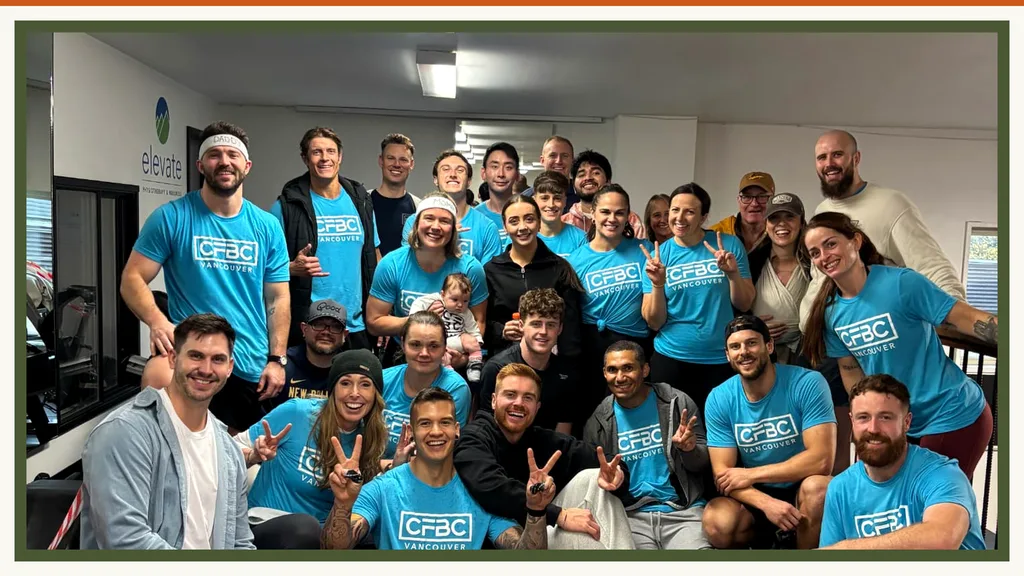
The People Who Train Beside You Started the Same Way
Here's what we wish everyone could see before their first class: the most motivating thing about CrossFit BC isn't the workout. It's looking around the room and knowing that the person next to you, the one who's now doing pull-ups and lifting twice their bodyweight, once walked through the same door feeling exactly the way you feel right now. Every single one of them.
Our community at 278 East 1st Avenue, Olympic Village includes:
- Parents who hadn't exercised in years
- Professionals who traded their lunch break for a barbell
- People recovering from injuries who needed expert guidance
- Retirees who wanted to stay strong and independent
- Former athletes getting back into it after a long break
- Complete beginners who had never touched a barbell in their lives
- People who tried other gyms and quit because nobody noticed when they stopped coming
Every single one of them was a beginner once. Every single one of them is glad they started.
What About Age? Is There an Age Where It's "Too Late"?
No. We train members in their 20s through their 70s. The approach changes, the scaling changes, and the programming priorities change, but the fundamental principle holds: your body adapts to the demands you place on it, regardless of age.
For adults 60+, we have a dedicated program called Living Legends: a 9-week coached strength training series designed specifically for that demographic. For everyone else, our regular classes with proper scaling accommodate the full spectrum of ages and abilities.
Read more: Why Lifting Weights After 50 Changes Everything
How CrossFit BC Helps You Start Safely
We don't just tell you to show up and figure it out. We've built a system specifically for getting beginners started the right way:
- Foundations program: learn every core movement with dedicated coaching before joining regular classes
- Movement screening: identify limitations and build your program around them
- Scaling every workout: coaches adjust in real time based on your ability
- Small class sizes: so you get real coaching attention, not just a spot in the room
- 30-Day Lifestyle Reset: a structured program with 8 PT sessions, group classes, nutrition coaching, and daily accountability for $999
- Personal training: 1-on-1 coaching for those who want the most individualized start possible
The Real Risk Isn't Starting Unfit. The Real Risk Is Waiting.
Every month you spend "getting ready" is a month of lost adaptation. A month where your muscle mass continues to decline (at a rate of 3-8% per decade after 30). A month where your bone density decreases. A month where your cardiovascular health deteriorates. A month where the gap between where you are and where you want to be gets wider.
The science is unambiguous: the best time to start resistance training and functional fitness is now, regardless of your current fitness level. Your body is designed to adapt. It's waiting for you to give it a reason to.
You Don't Need to Be Ready. You Just Need to Start.
The right time to start isn't when you're fit enough. It's when you're honest enough to admit that waiting hasn't worked. And if you're reading this article right now? That honesty is already there.
Try 3 classes free, no commitment, no pressure. Or if you want a structured start with coaching, assessment, and accountability, explore the 30-Day Lifestyle Reset.
We're at 278 East 1st Avenue, Olympic Village, Vancouver. We'd love to meet you. Come as you are.