CrossFit vs HYROX Was the Wrong Question
The tribes argument was always a distraction. The athlete who wins the next decade trains all four engines on purpose, and the question is no longer which sport, but which life.
The "CrossFit vs HYROX" debate sells clicks. It does not build athletes. We have coached both sports, on the same floor, every week, for years. And the longer we do this, the more obvious it gets: the question itself is wrong. It is a tribal question dressed up as a programming question, and tribal questions never produce useful answers. The better question, the one that actually changes how you train and how you live, is this: which engines do you need for the life you want, and how do you build all of them without breaking?
If you are still new to the sport, here is what HYROX actually is, and why everyone's training for it.
Ask that question, and the conversation moves from chest-thumping to programming. From identity to outcomes. From which logo is on your shirt to which capacities are in your body. That is where the next decade of fitness gets decided, and that is the conversation we want to have.
Why the tribal question keeps getting asked
Algorithms reward fights. CrossFit vs HYROX is a fight, so the internet keeps feeding it. There are entire podcast episodes, YouTube videos, and Reddit threads dedicated to who would win, who is harder, who is more legit. It is fun. It is also almost entirely useless for the person trying to decide how to spend their next four training hours a week.
The truth coaches see on the floor is much less satisfying than a feud. A strong CrossFit athlete who has never trained pace will absolutely cook themselves on a HYROX SkiErg interval. A strong HYROX athlete who has never strung gymnastics under fatigue will fail a workout that has muscle-ups in the back half. Neither of those facts settles anything about the sports. They settle something about the athletes. The format exposed a missing engine. That is all.
If you want to read where we landed on the head-to-head, the long version is in CrossFit Athlete vs HYROX Athlete: Who Wins?. The short version: the winner depends on the test. Pick the test, pick the winner. Which is why arguing about the tribes is the wrong place to put your attention.
The four engines every adult athlete needs
Here is the frame we coach with. Forget the brands for a second. A real human body, the kind that has to lift kids, climb mountains, sit on flights, recover from stress, and stay capable into the sixties and seventies, runs on four engines. You need all of them. Most people train one or two.
1. Strength
The ability to produce force against an external load. Squat, deadlift, press, pull. This is the engine that protects bone density, joint integrity, and your ability to pick a grandchild up off the floor at 72. It is also the most under-trained engine in the endurance world and the most over-glorified one in the aesthetic world. Real strength is boring to film and impossible to fake.
2. Power
Strength expressed quickly. Jumps, throws, Olympic lifts, sprints. Power is the first physical capacity to leave the body with age, and the one most directly linked to falls, frailty, and a loss of independence after 60. Train it on purpose, in small doses, every week of your adult life.
3. Mixed-modal capacity
The ability to repeat hard efforts under fatigue, across different movement patterns, without form falling apart. This is the engine CrossFit built its reputation on, and it is the one most office-bound athletes are wildly underprepared for. It is also the engine that makes you genuinely useful in real-world emergencies.
4. Steady aerobic durability
The ability to hold a workable pace for 30, 60, 90 minutes without redlining. Zone 2 work, long runs, long rides, long rows. This is the engine HYROX rewards and the one that, more than any other, predicts how long you live well. The longevity literature on VO2 max is not subtle, and there is no shortcut to the aerobic base that produces it.
Why "pick one sport" stops working in your thirties
In your twenties you can specialise hard and get away with it. Pure CrossFit, pure marathon, pure powerlifting. The body absorbs the imbalance because everything else is still working. Recovery is free. Sleep debt costs nothing. Hormones cover up programming sins.
In your thirties the bill arrives. The marathoner with no strength loses bone density and starts breaking metatarsals. The CrossFit specialist with no aerobic base finds that anything longer than 15 minutes shreds them. The powerlifter with no engine cannot hike with their family without resenting it. Specialisation is a young person's strategy. After 35, it slowly becomes a liability.
This is not a CrossFit problem or a HYROX problem. It is a single-engine problem. Both communities produce specialists. Both communities produce hybrid athletes. The deciding variable is not the logo, it is the programming intent.

What hybrid training actually means
Hybrid training has become a marketing word, which is unfortunate, because the idea is genuinely good. Stripped of the noise, it means this: deliberately training more than one capacity in the same training week, in a way that the capacities support rather than sabotage each other.
For most adult athletes, a workable hybrid week looks something like:
- 2 strength days. Squat, hinge, push, pull, accessory. Heavy enough to stimulate, light enough to recover from.
- 2 mixed-modal days. Conditioning that includes both barbell and bodyweight, both anaerobic and aerobic windows. Coached, scaled, intent on movement quality.
- 1 long aerobic day. Zone 2. 45 to 90 minutes. Heart rate capped. Boring on purpose.
- 1 sport or race-specific day. SIM-ilar for HYROX athletes, partner WOD for the CrossFit crowd, a long ride, a hike, a trail run, a pickup game.
- 1 honest rest day. Mobility, walk, nap. Not "active recovery" code for another workout.
That is a hybrid week. It is not exotic. It is not new. It is the boringly correct answer to the question "how do I train all four engines without breaking." If your current week looks nothing like that, the issue is not which gym you train at. It is which engines you have been ignoring.
If you want to see what this looks like in practice, our Hybrid Training at CFBC page lays out the weekly structure, and the HYROX program and CrossFit program pages show how athletes layer race-specific work on top of the foundation.
Pick a sport for the joy. Program the missing engines around it.
Here is the simplest reframe we give members who come in stuck in the tribal question. Pick a sport because you love it. Then program the missing engines around it.
If CrossFit is the sport that makes you train hard, train often, and stay accountable, do CrossFit. Then add a weekly long aerobic piece and protect a real strength day. The variety of the sport already trains three of the four engines. You are buying one missing engine for the price of one weekly session.
If HYROX is the sport that lights you up, train HYROX. Then add two real strength sessions a week. The race itself trains the aerobic and mixed-modal engines beautifully, but it under-trains pure strength and pure power. Buy those two engines on purpose, and your race times improve as a side effect.
If neither speaks to you, that is fine. Pick the sport you will actually show up to. Run club. Olympic lifting. Olympic-distance triathlon. Hockey beer league. Then build the hybrid week around it. The sport is the reason you train. The engines are the reason you keep training for the next forty years.
What we coach at CFBC, in plain English
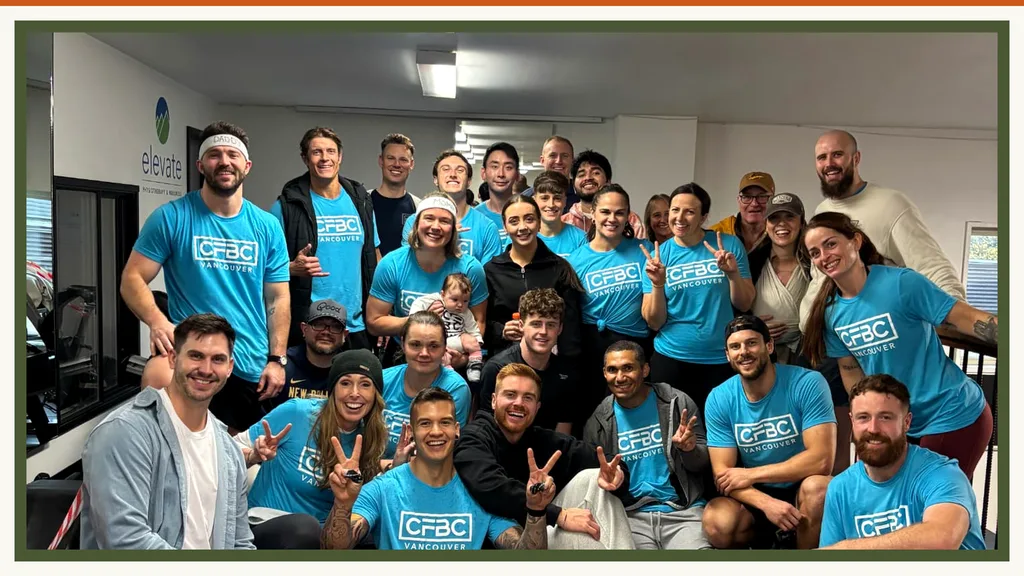
At CrossFit BC we coach both CrossFit and HYROX, and a meaningful chunk of our members do both. We also run a strength program, an Olympic lifting class, a run club, and a 30-Day Lifestyle Reset for athletes who need to rebuild the basics before they pick a sport.
The reason we offer all of it is not a marketing strategy. It is the same reason this article exists. Real humans need real engines. The tribes argument has never built a single one of them. Coaching has. Our coaches are paid to ask the boring question first, every time: which engines are missing, and how do we build them without breaking the athlete we have in front of us.
If you are stuck in the tribal question, the best thing we can offer you is an honest conversation. The free intro is exactly that. Thirty minutes, no pressure, a coach looking at your training history and your life and pointing at the missing engine. Most people leave with a clearer plan than they have had in years. A few sign up. Most do not, that week, and we are fine with that. The plan is the point.
Where to go next
If this resonated, three honest next steps:
- Read the long form on the head-to-head: CrossFit Athlete vs HYROX Athlete: Who Wins?
- Read the case for hybrid: Why the Future Belongs to the Hybrid Athlete.
- Book a free intro and let a coach map your missing engines on paper. Thirty minutes. No pitch. A real plan.
The tribes argument will keep getting louder. Your training does not have to.