
The 5 Best Protein Powders for Hot Drinks (Coffee, Hot Chocolate, and More)
Dump a scoop of whey into fresh coffee and you get a mug of tiny cottage cheese. Here is what the research says about heat and protein, five picks that work in a hot mug, and a ten second method that fixes the clumps.
Dump a scoop of whey into fresh coffee and you get a mug of tiny cottage cheese. It tastes fine and looks awful, and it is the main reason people quit protein coffee after two tries. The fix takes about ten seconds. Here is what the research says about heat and protein, which powders hold up in a hot mug, and how to make a morning drink that earns its place in your day.
Disclosure: some links in this article are Amazon affiliate links. If you buy through them, CrossFit BC earns a small commission at no extra cost to you. We only link products we would hand to our own members. As an Amazon Associate I earn from qualifying purchases.
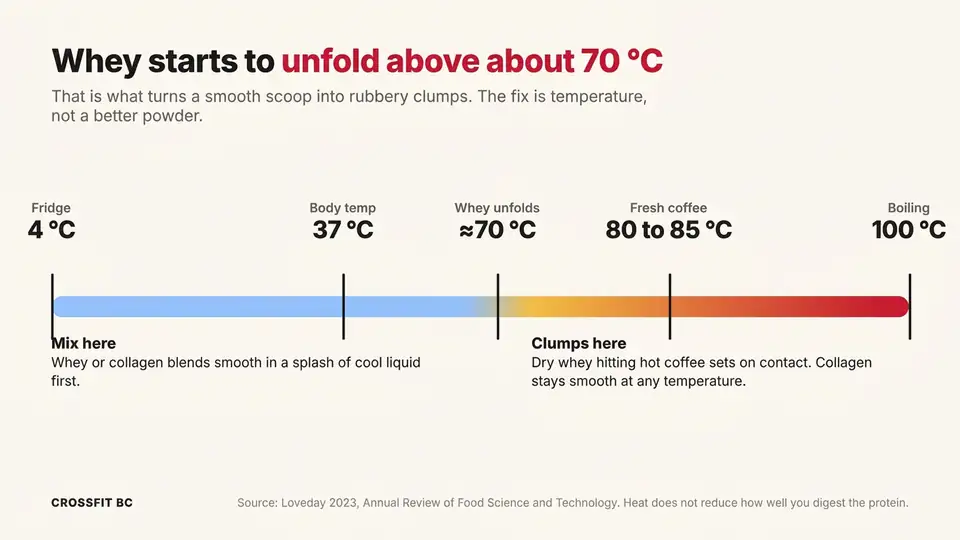
Quick answer: Yes, you can put protein powder in hot coffee, but pick the right kind. Collagen peptides stir straight in. Whey clumps when it hits liquid hotter than roughly 70 degrees Celsius, so make a paste with a little cool liquid first, then pour the coffee in slowly.
What heat does to protein powder
Heat unfolds protein. That is called denaturation, and it is why an egg turns solid in a pan. The main whey protein, beta-lactoglobulin, starts to unfold above roughly 70 °C [1], and fresh-brewed coffee is hot enough to cross that line. Unfolded proteins stick to each other, and the sticking is your lumps.
The lumps are a texture problem. A 2023 review of the human and pig evidence found that moderate heat tends to make proteins easier for digestive enzymes to cut, and that whey is absorbed quickly even when it is intact [2]. Real losses showed up with extreme heat combined with alkaline conditions or reducing sugars [2]. A mug of coffee is nowhere near that.
Which powder works in a hot mug
| Type | In hot coffee | Best for | The catch |
|---|---|---|---|
| Collagen peptides | Stirs in with a spoon | Easy protein top-up, joint and skin goals | Incomplete protein, no tryptophan [3] |
| Whey isolate | Smooth if you make a paste first | Muscle and a complete protein | Clumps if you add it dry |
| Plant blend | Varies by brand, use a frother | Dairy-free | Often lower in essential amino acids [2] |
Collagen dissolves. Whey builds more muscle.
Collagen contains no tryptophan, one of the nine essential amino acids, so nutrition scientists class it as an incomplete protein [3]. In a trial of healthy older women, whey raised muscle protein synthesis more than collagen did, both at rest and after resistance exercise [4]. Collagen in your coffee is a nice extra. It should not be your protein foundation.
One caution on the collagen research: the paper behind the 2.5 to 15 g daily doses was written by authors tied to collagen companies, so read it as the industry's best case [3]. Its own calculation says collagen can supply up to about 36% of daily protein without upsetting the amino acid balance of a typical diet [3]. A scoop around 10 g fits comfortably inside that.
How much protein is enough
A meta-analysis of 49 studies and 1,863 people found that protein supplementation improved the muscle and strength gains from resistance training, and that the benefit levelled off at about 1.6 g per kg of body weight per day [5]. For an 80 kg person that is roughly 130 g a day. The paper's confidence interval ran higher, so people who train hard can reasonably aim above that.
A protein coffee delivers 10 to 25 g. It is one piece of the day, so count it and build the rest around real food.
Where caffeine fits
The International Society of Sports Nutrition says 3 to 6 mg of caffeine per kg of body weight reliably helps performance, usually taken about 60 minutes before training, and that doses as low as 2 mg/kg may work [6]. Health Canada sets the ceiling for healthy adults at 400 mg a day, and 300 mg if you are pregnant or breastfeeding [7].
For an 80 kg person, 3 mg/kg is 240 mg. Health Canada puts 400 mg at about three 8 oz cups [8], which makes 240 mg a little under two cups. Cup strength varies, and many of the trials used capsules, so treat that as a starting point and see how you feel.
How to mix it without lumps
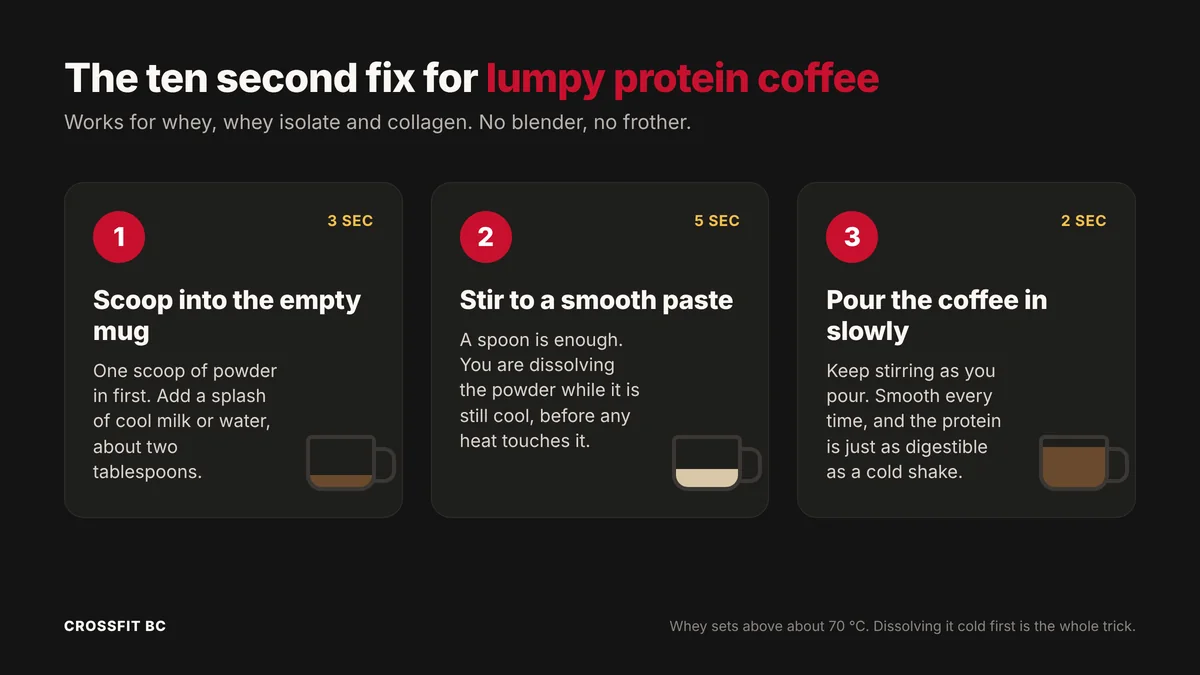
- Collagen: pour your coffee, add a scoop, stir with a spoon.
- Whey: put the scoop in your mug first. Add two or three tablespoons of cool water or milk and stir to a smooth paste. Pour the hot coffee in slowly while you stir or froth. If you can, let the coffee sit a minute or two first.
- Iced coffee: shake the whey with cold milk in a bottle, then pour it over the coffee.
Our picks
Every pick below is something we would hand a member across the front desk. We say what testing each brand reports, and when a pick has no sport certification we say that too. NSF Certified for Sport checks that the label matches the tub, screens for contaminants and tests for roughly 290 substances banned by major sports bodies [9].
1. Vital Proteins Collagen Peptides (Unflavoured)
The simplest option. One ingredient, and it stirs into hot coffee with a spoon. The brand's unflavoured collagen peptides carry NSF Certified for Sport certification, so look for the mark on the tub you buy.
Check the price on Amazon.ca (affiliate)
2. Organika Enhanced Collagen
A BC company, and a hydrolyzed bovine collagen that behaves the same way in a hot mug. Organika states its products are third-party tested. It does not carry a sport certification.
Check the price on Amazon.ca (affiliate)
3. Sports Research Collagen Peptides
Single ingredient, usually priced below the first two. The brand reports third-party testing.
Check the price on Amazon.ca (affiliate)
4. Vital Proteins Collagen Creamer (Vanilla)
For lattes and hot chocolate. Each 15 g serving provides 6 g of collagen. Collagen with coconut milk powder, so it adds creaminess and a light vanilla note. A frother helps it go silky.
Check the price on Amazon.ca (affiliate)
5. Kaizen Naturals Whey Protein Concentrate (Vanilla, with the tempering trick)
The complete-protein pick for anyone who wants muscle support. Kaizen is a Canadian brand and states its contents are NSF tested and certified, which verifies what is in the tub. That is a different program from NSF Certified for Sport. Never dump it into a hot mug. Make the paste first, as above.
Check the price on Amazon.ca (affiliate)
The bottom line
If you want zero effort, buy an unflavoured collagen and stir a scoop into whatever hot drink you already make. If you want the protein to count toward muscle, make the paste and use a whey isolate, or drink your shake cold and keep the coffee for pleasure.
Want your protein, training and recovery working together? Book a free trial class and a coach will help you build it. Questions about what your own nutrition should look like around training? That is what our nutrition coaching is for, and your first conversation is free.
Written by Dai Manuel (Coach Moose), who has 30 years of coaching experience, Precision Nutrition and CrossFit Nutrition training, and ongoing continuing education in nutrition and performance.
Keep reading
- Protein calculator: find out how much protein you actually need each day.
- Creatine monohydrate guide: the other supplement with strong evidence behind it.
- Proteinmaxxing vs fibremaxxing: why protein and fibre work best together.
- Why the scale is lying: tracking muscle, not just weight.
- Edge Test and DEXA + Nutrition Strategy: measure your lean mass and get a protein plan built around it.
References
- Beta-lactoglobulin denatures above 70 °C: Int Dairy J, kinetic modelling review and J Dairy Sci, thermal marker study, which found no significant change below 70 °C and a transition between 70 and 80 °C.
- Loveday SM. Protein digestion and absorption: the influence of food processing. Nutrition Research Reviews 2023;36(2):544-559.
- Paul C, Leser S, Oesser S. Significant amounts of functional collagen peptides can be incorporated in the diet while maintaining indispensable amino acid balance. Nutrients 2019;11(5):1079. Authors are affiliated with collagen and supplement companies.
- Oikawa SY et al. Whey protein but not collagen peptides stimulate acute and longer-term muscle protein synthesis with and without resistance exercise in healthy older women. 2020.
- Morton RW et al. A systematic review, meta-analysis and meta-regression of the effect of protein supplementation on resistance training-induced gains in muscle mass and strength in healthy adults. Br J Sports Med 2018;52(6):376-384.
- Guest NS et al. International Society of Sports Nutrition position stand: caffeine and exercise performance. J Int Soc Sports Nutr 2021;18(1):1.
- Health Canada. Caffeine in foods.
- Health Canada. Advisory on safe levels of caffeine consumption, 25 May 2017 (archived page).
- NSF. Certified for Sport: what our mark means.