
HYROX Training in Vancouver: How to Prepare Without Burning Out
HYROX is the fastest-growing fitness race in the world, and Vancouver's scene is booming. Here's everything you need to train smart, avoid burnout, and find your race-day edge.
HYROX has gone from a niche European fitness race to a global phenomenon, and Vancouver is one of the hottest scenes in North America. If you've seen friends posting finisher photos, heard the buzz at your gym, or started Googling "HYROX near me," you're in the right place.
But here's what most HYROX content won't tell you: the biggest risk in preparing for this race isn't undertraining. It's overtraining. It's going too hard, too soon, for too long, and arriving at race day flat, beat up, or injured.
At CrossFit BC, we're a HYROX affiliated training club in Vancouver's Olympic Village. Our coaching team doesn't just program HYROX workouts. They've raced, they've trained alongside the athletes they coach, and they've watched what happens when people train smart versus when they just train hard. This guide is about training smart.
What Is HYROX? The Race Format Explained
HYROX is a standardized indoor fitness race. Every race, everywhere in the world, follows the exact same format:
- 8 x 1 km runs, alternating with 8 functional workout stations
- Total running: 8 km
- Total stations: 8
The stations, in order:
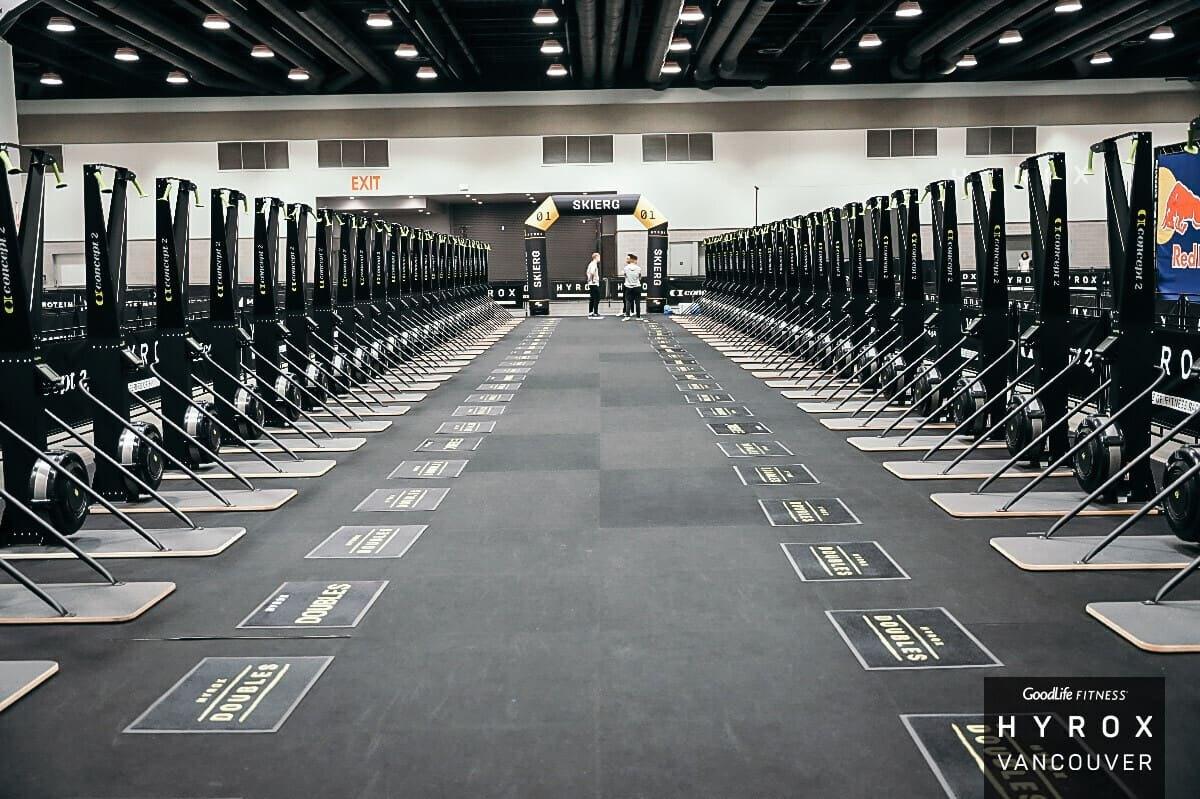
- SkiErg (1,000m)
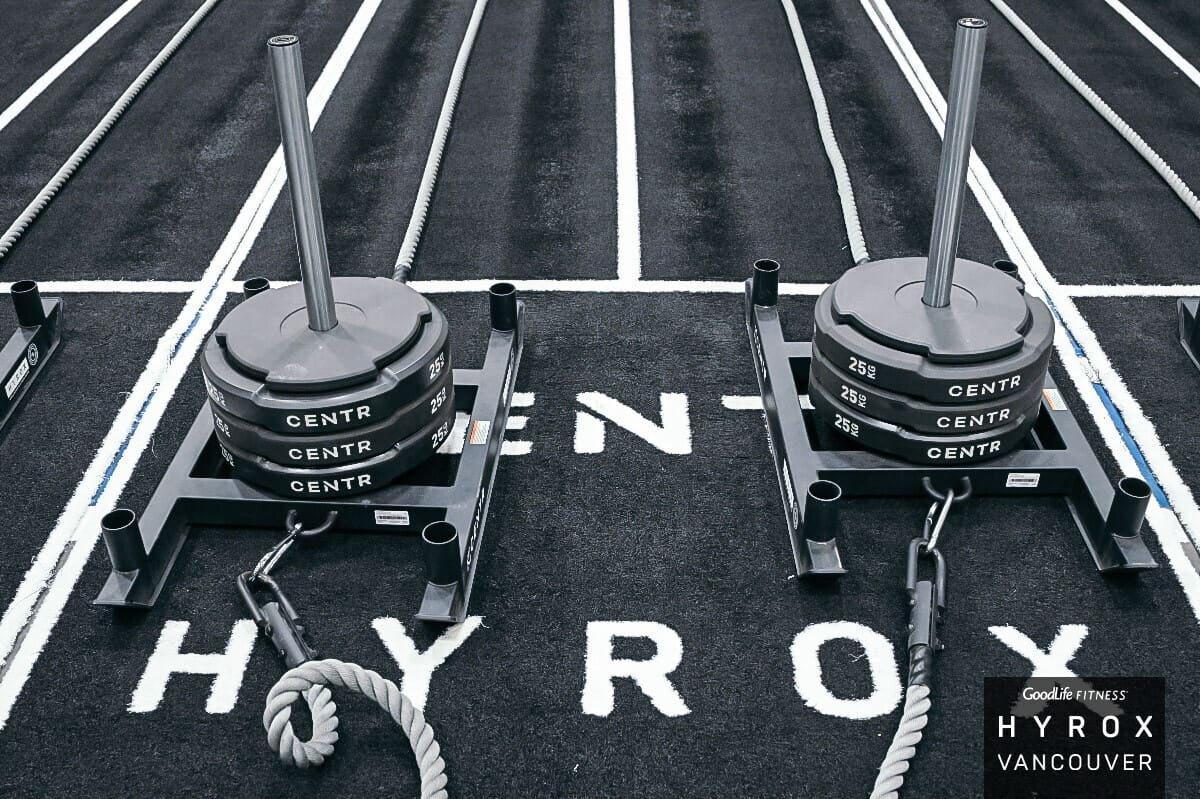
- Sled Push (50m)
- Sled Pull (50m)
- Burpee Broad Jumps (80m)
- Rowing (1,000m)
- Farmers Carry (200m)
- Sandbag Lunges (100m)
- Wall Balls (100 reps)
Weights vary by division (Open, Pro, Relay, Doubles). The race is designed for everyone, from first-timers finishing in 90+ minutes to elite athletes targeting sub-60. You race against the clock, not against other people, unless you want to.
The standardized format is what makes HYROX unique. Unlike obstacle course races where the course changes every event, HYROX is the same everywhere. That means you can train for it specifically, measure your progress objectively, and compare your times globally.
Why Most People Train for HYROX Wrong
The biggest mistake we see? Training like a runner who adds some weights, or a CrossFitter who adds some running. HYROX demands a very specific kind of fitness: sustained output under fatigue. That's a distinct skill, and it requires distinct training.
Running Economy, Not Running Speed
You don't need a fast 5K time. You need the ability to hold a steady pace after doing sled pushes, wall balls, and burpees. That's "running economy": how efficiently you move when tired.
This means your training shouldn't be all about track intervals or 10K PRs. It should include running off of stations, practicing the transition from station to run, again and again, until your legs remember what to do.
Strength Endurance, Not Maximal Strength
HYROX isn't a powerlifting meet. You don't need a 400 lb squat. You need to move sub-maximal weight (sleds, sandbags, wall balls) over and over without your form falling apart.
If your training is all heavy triples and PR attempts, you'll be strong in a way that doesn't transfer. Shift toward higher reps, lighter loads, and metabolic circuits.
Station-Specific Technique
Every station has a technique that, once dialed in, can save you minutes. Most people don't know this. They brute-force through, get gassed, and leave time on the table.
At CrossFit BC, we break down each station individually. Wall ball rhythm. Sled push body angle. Farmers carry grip strategy. Burpee broad jump cadence. These are teachable skills.
The Pacing Trap
First-time racers almost always start too fast. Adrenaline kicks in, the atmosphere is electric, and they crush the first run. Then they hit the first station and realize they have 7 more runs and 7 more stations to go, and now their heart rate is redlined.
Smart pacing is a learned skill. It takes practice, specifically, practice of full HYROX simulations, not just workouts that feel hard.
The Burnout Problem: Why HYROX Training Breaks People
Here's the paradox. HYROX attracts high-motivation, high-commitment people. Those are exactly the people most at risk of overtraining themselves into injury or burnout.
Why HYROX Training Burns People Out
- It feels productive. Every workout is brutal, so every workout feels like progress.
- It's measurable. You can track your 1 km run pace, your sled push time, your wall ball unbroken sets. Measurability is motivating, and addictive.
- The race date is fixed. When you know your race is in 12 weeks, it's tempting to cram.
- Social pressure. Training partners are pushing hard. Instagram is full of PRs. You don't want to be the one taking a rest day.
Signs You're Overtraining
- Sleep is worse, not better, despite training hard.
- Resting heart rate is elevated.
- Workouts feel harder than they should.
- Recovery between sessions is taking longer.
- Mood is off. Motivation is dropping.
- Nagging injuries won't go away.
If you're seeing two or more of these, you're already in the danger zone. The solution isn't to push through. It's to pull back.
The Sustainable Training Split
Most athletes we work with train 4-5 days per week for HYROX, not 6-7. Here's why: recovery is when adaptation happens. You don't get fitter during the workout. You get fitter in the hours after, when your body rebuilds stronger.
Six or seven days of hard training doesn't leave enough recovery space. You accumulate fatigue faster than you adapt. Progress stalls. Injury risk climbs.
Recovery as a Training Tool
Sleep. Protein. Mobility. Zone 2 cardio. These aren't afterthoughts. They're what makes your training work. If you're skipping them because they don't feel like "real training," you're leaving huge gains on the table.
A Station-by-Station Breakdown (With Training Tips)
Station 1: SkiErg (1,000m)
The SkiErg is the opener, and it sets the tone. Go too hard here and you're cooked for the rest of the race. Go too easy and you lose time you can't recover.
Training tip: Practice 500m repeats at race pace, with short rest. Your goal is to hit a pace you can sustain even with elevated heart rate.
Station 2: Sled Push (50m)
The sled push is where races are won and lost. Heavy, painful, and comes early in the race (station 2), so the temptation is to redline it.
Training tip: Practice sled pushes in the context of a run. Do a 400m run, then immediately a sled push. That's race conditions. Build your mental and physical tolerance for the transition.
Station 3: Sled Pull (50m)
The sled pull demands grip, back, and leg endurance in equal measure. Your grip is usually the limiter.
Training tip: Train grip directly. Farmer carries, dead hangs, heavy rows. Don't only train the sled pull motion, train the underlying capacities.
Station 4: Burpee Broad Jumps (80m)
The hardest station for most people, and it comes in the middle of the race when you're already tired. Technique matters more than speed here.
Training tip: Shorter, controlled broad jumps beat longer, sloppy ones. Consistency wins. Practice the rhythm until it's automatic.
Station 5: Rowing (1,000m)
By station 5, the race is halfway done and you're tired. Rowing lets you sit down for a minute, but don't waste that recovery by pacing poorly.
Training tip: Practice 1 km rows after hard intervals. Teach your body to pace a row when your legs and lungs are already taxed.
Station 6: Farmers Carry (200m)
Heavy dumbbells for 200 metres. Grip and posture are the battle. Shoulders back, ribs stacked, and don't put the dumbbells down.
Training tip: Long-duration carries in training (60–90 seconds) build the tolerance for that grip burn that otherwise will stop you cold.
Station 7: Sandbag Lunges (100m)
The second-hardest station for most. Lunging with weight on your back after 45 minutes of racing is a unique kind of suffering.
Training tip: Practice lunges fresh (perfect form) and fatigued (real-world conditions). Both matter.
Station 8: Wall Balls (100 reps)
The final station, and for most people the station where the race is either locked in or falls apart. 100 wall balls at a 9 kg (20 lb) or 6 kg (14 lb) target. Relentless.
Training tip: Learn to break up your wall balls before you're forced to. Sets of 25, 20, 20, 15, 10, 10 is often faster than trying to go unbroken and failing at rep 40.
How to Build Your HYROX Training Plan
The 3-Phase Approach
- Base Phase (4-8 weeks): Build aerobic capacity and work tolerance. Zone 2 running. General strength. Station technique.
- Specific Phase (4-6 weeks): Race-pace work. Full simulations. Transitions. Station-specific strength endurance.
- Taper (2 weeks): Reduce volume, keep intensity. Sleep more. Get fresh.
How Many Days Per Week
Four to five hard sessions per week is the sweet spot for most people. Mix of running days, strength days, and full HYROX-style conditioning. Add one or two easy Zone 2 days, and one full rest day.
Balancing Running, Strength, and Station Work
A typical week:
- 1x running-focused session (intervals or tempo)
- 1x strength-focused session (compound lifts, moderate volume)
- 1-2x HYROX simulation (full or partial)
- 1x easy Zone 2 run (45-60 min)
- 1x active recovery / mobility
How We Train HYROX Athletes at CrossFit BC
90-Minute SIM-ilar Classes (The Game Changer)
Our flagship HYROX offering is our 90-minute simulation-style class. It mimics full race conditions: 8 runs, 8 stations, clock running. Your body learns what 90 minutes to two hours of sustained effort feels like, something you cannot fake.
Station-Specific Skill Work
Weekly sessions drilling down on individual stations. Wall ball technique one week. Sled push body mechanics the next. These aren't sexy, but they're where time gets shaved off.
Hybrid Conditioning
We mix rowing, skiing, running, and lifting in non-HYROX patterns to build general metabolic fitness. The race demands adaptability, our training builds it.
CrossFit-Powered Base
Underneath the HYROX-specific work sits a CrossFit foundation: compound strength, gymnastics capacity, mixed-modal conditioning. That base is what lets our athletes absorb HYROX-specific volume without breaking down.
HYROX for Beginners: A Realistic Timeline
If you're new to HYROX, here's what we actually recommend:
- Months 1-2: Build a general fitness base. CrossFit classes, steady running, learn the movements.
- Months 2-3: Start adding HYROX-specific work. Sled pushes, sandbag lunges, wall balls.
- Month 3-4: Do a partial simulation (4 runs, 4 stations). See how it feels.
- Month 4-5: Full simulations. Refine pacing.
- Month 5-6: Race week. Taper. Show up fresh.
A 6-month ramp to your first race is realistic, sustainable, and will leave you stronger at the end than when you started.
HYROX vs CrossFit: How They Complement Each Other
A lot of people think they have to pick one or the other. You don't. HYROX and CrossFit are complementary, not competing.
CrossFit builds the strength, power, and broad fitness base that makes HYROX training possible. HYROX gives you a measurable goal, a race environment, and a specific application for that base. Our best HYROX athletes are also our best CrossFitters.
Nutrition and Recovery for HYROX
Fueling Training
HYROX training burns serious calories. Under-eating will wreck your recovery. Prioritize:
- Protein: 1.6-2.0 g per kg bodyweight daily
- Carbs: More than you think. Around training especially.
- Fats: 25-30% of calories. Healthy sources.
- Hydration: Electrolytes matter, especially in summer training.
Race Week Nutrition
Don't experiment. Eat foods you've eaten before. Carb-load moderately in the 2-3 days before. Hydrate well, especially if you're travelling. Keep caffeine at your normal levels, race day isn't when to try a new supplement.
Race Day: What Nobody Tells You
The Atmosphere Is Electric
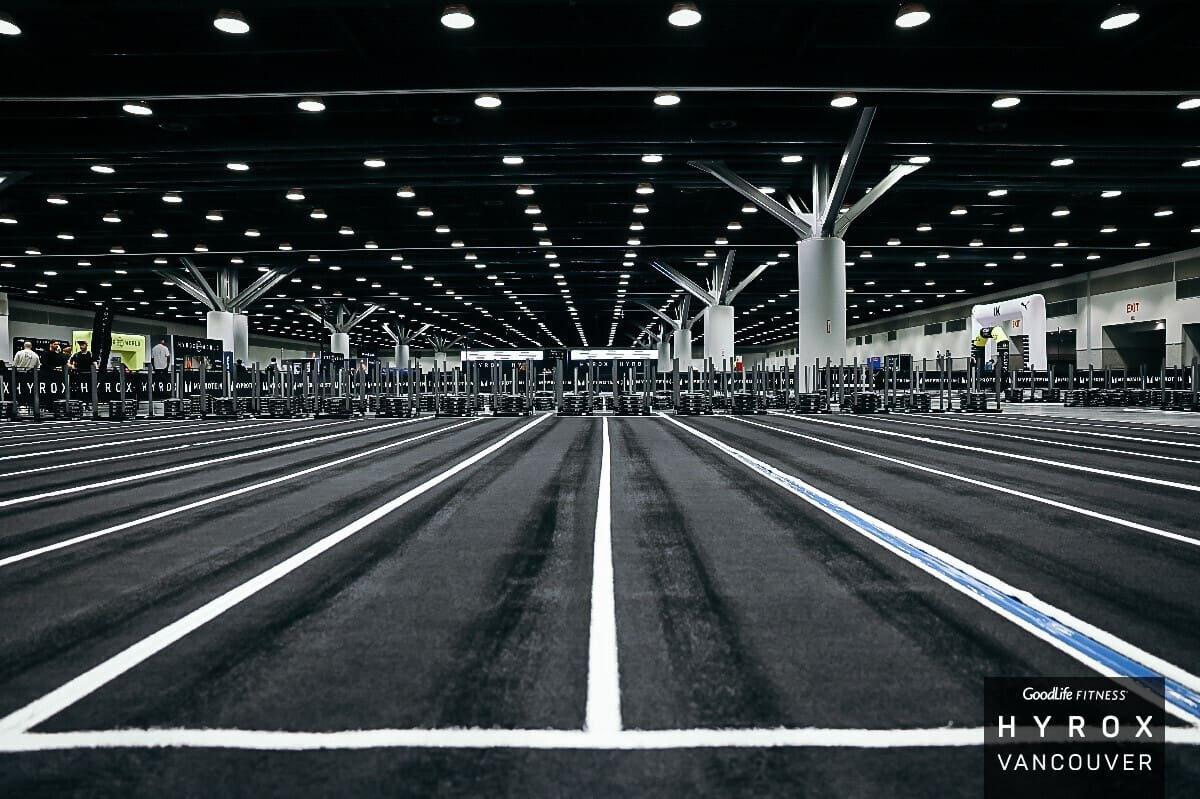
HYROX events are massive. Thousands of athletes, loud music, crowds cheering. This lifts you, and it can also push you to start too fast. Plan your pacing before you step on the start line.
Transition Zones Matter
Move with purpose between stations. Don't sprint, that'll cost you. Don't dawdle either. A smooth, efficient transition can save you 30-60 seconds across the race.
The Second Half Is Where Races Are Won
Stations 5-8 are where most people fall apart. If you've trained for fatigue and paced well, you'll pass people in the back half. It's a magical feeling.
You Will Surprise Yourself
Almost every first-timer we've coached finishes faster than they thought possible. The atmosphere, the training, the adrenaline, it all combines. Trust your prep.

What to Look for in a HYROX Training Gym
Not every gym is built for HYROX. When you're choosing where to train, look for:
- HYROX affiliation, gyms that have been certified by HYROX to deliver race-specific training.
- The right equipment, SkiErgs, rowers, sleds, sandbags, wall balls. All of it.
- Experienced coaches, ideally, coaches who've raced HYROX themselves.
- Full simulations, not just workouts, but opportunities to run the whole format.
- Community, training partners who'll push you and celebrate with you.
Come Train With Us
CrossFit BC is a HYROX affiliated training club in Vancouver's Olympic Village. We offer:
- 90-minute SIM-ilar classes
- Station-specific skill work
- Full HYROX simulations
- One-on-one coaching for competitive athletes
- A community of racers who train hard and support each other
Whether you're prepping for your first HYROX or chasing a podium time, we'll meet you where you are and help you show up at your best on race day.
Ready to get started? Book your 3 free classes, take our coaching fit quiz, or learn about our CrossROX hybrid competitions.
If you've got a race date locked in, layer this onto our 12-week HYROX race prep timeline, the same phased structure we run with Vancouver athletes from base block through race week.
If you are still deciding whether HYROX is the right race for you, start with our HYROX primer: what the format actually is and why it has become the fastest-growing fitness sport in the world.