
Fitness in 100 Words: The Only Workout Plan You'll Ever Need
CrossFit's founder once defined fitness in exactly 100 words. We've coached against that definition for fifteen years. Here's what still holds up, and what we'd add now.
"Eat meat and vegetables, nuts and seeds, some fruit, little starch, and no sugar."
That's how it starts. Not with a supplement stack. Not with a 12-week periodization spreadsheet. Not with a $200/month app. It starts with food.
CrossFit's "Fitness in 100 Words" is arguably the most concise, complete fitness prescription ever written. It was published by CrossFit founder Greg Glassman over two decades ago, and it hasn't needed an update since. Because when something is built on first principles, it doesn't expire.
Let's break it down, line by line, and talk about what it actually looks like to live this way.
The Full Text: Fitness in 100 Words
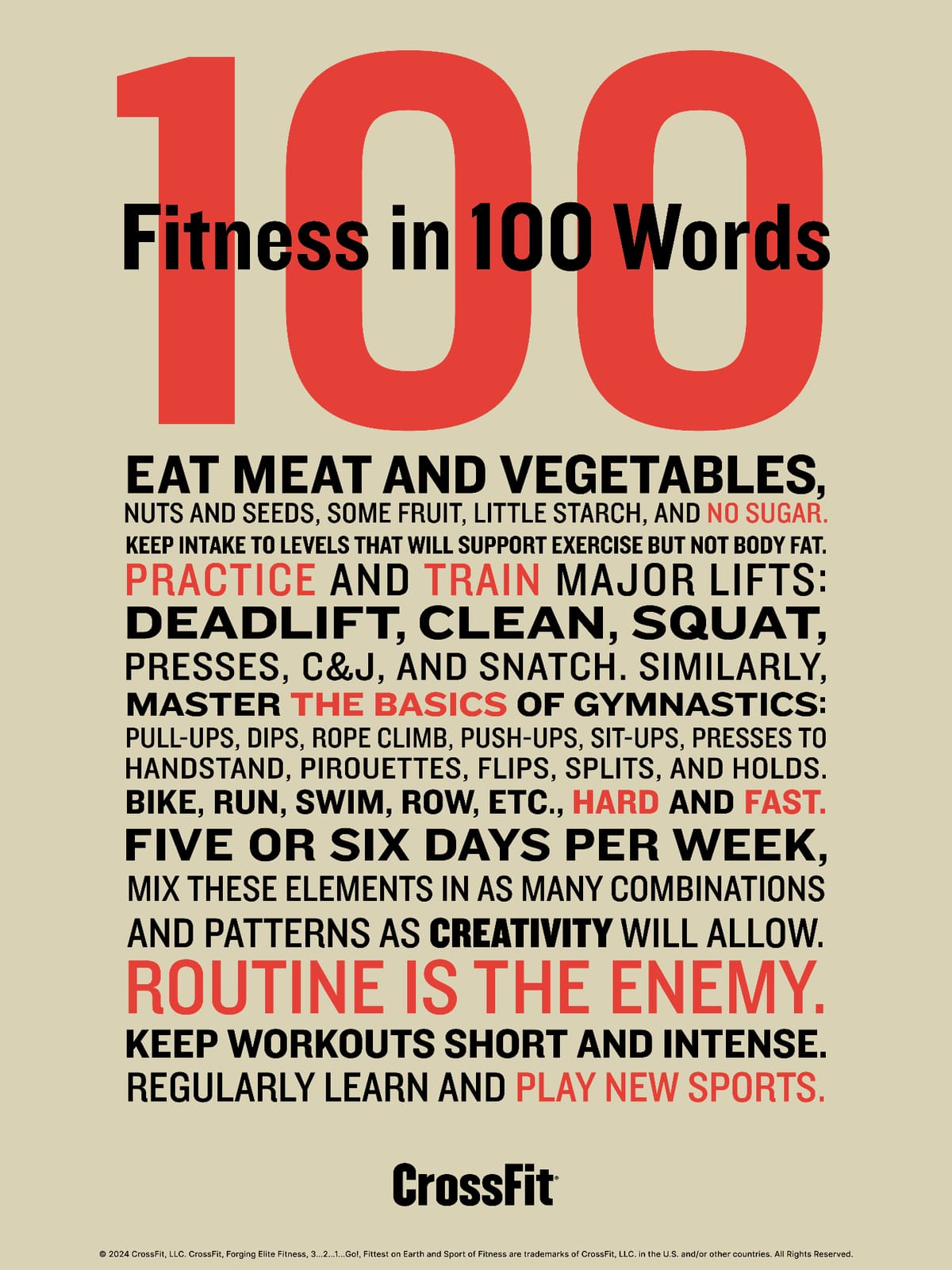
Here it is, word for word:
Eat meat and vegetables, nuts and seeds, some fruit, little starch, and no sugar. Keep intake to levels that will support exercise but not body fat. Practice and train major lifts: deadlift, clean, squat, presses, C&J, and snatch. Similarly, master the basics of gymnastics: pull-ups, dips, rope climb, push-ups, sit-ups, presses to handstand, pirouettes, flips, splits, and holds. Bike, run, swim, row, etc. hard and fast. Five or six days per week. Mix these elements in as many combinations and patterns as creativity will allow. Routine is the enemy. Keep workouts short and intense. Regularly learn and play new sports.
That's it. Everything you need. Let's unpack it.
Start With Food (Because Nothing Else Works Without It)
"Eat meat and vegetables, nuts and seeds, some fruit, little starch, and no sugar."
No calorie counting. No macro tracking. No eliminating entire food groups. Just a clear hierarchy: whole, unprocessed foods at the center of your plate.
Here's the thing: we've watched hundreds of people walk through our doors at CrossFit BC, and the ones who make the fastest, most lasting progress are almost always the ones who clean up their nutrition first. Not perfectly. Just consistently.
"Keep intake to levels that will support exercise but not body fat." That single sentence replaces every diet book on the shelf. Eat enough to fuel your training. Not so much that you're storing excess. You don't need an app for that. You need awareness.
Lift Heavy Things (The Right Way)
"Practice and train major lifts: deadlift, clean, squat, presses, C&J, and snatch."
Notice it says practice and train. Those are two different things. Practice is about skill acquisition, moving well, building motor patterns. Training is about intensity, loading, pushing your capacity.
These aren't random exercises pulled from a magazine. These are compound, functional movements that mimic how humans were built to move: picking things up, standing up with them, pressing them overhead. Research consistently shows that compound barbell movements build more strength, bone density, and metabolic health than isolation exercises.
At CrossFit BC, every new member starts with coached sessions to learn these lifts safely. We don't hand you a barbell and say good luck. We walk you through every position, every cue, every progression.
Master Your Own Body
"Master the basics of gymnastics: pull-ups, dips, rope climb, push-ups, sit-ups, presses to handstand, pirouettes, flips, splits, and holds."
Before you panic: nobody expects you to do a backflip on day one. "Gymnastics" in this context means bodyweight control. Can you push yourself off the ground? Can you hang from a bar? Can you hold your body in space?
These movements build relative strength (strength relative to your body weight), coordination, balance, flexibility, and spatial awareness. They're also incredibly humbling. We've seen former athletes walk in and struggle with a strict pull-up. And that's okay. That's where growth starts.
Move Fast, Move Often
"Bike, run, swim, row, etc. hard and fast. Five or six days per week."
Two things stand out here. First: hard and fast. Not long and slow. Not 45 minutes on the elliptical at a conversational pace. High-intensity effort. Short duration. Maximum output.
The science backs this up. A 2019 meta-analysis published in the British Journal of Sports Medicine found that high-intensity interval training (HIIT) reduces body fat 28.5% more effectively than moderate-intensity continuous training. And it does it in less time.
Second: five or six days per week. This is a lifestyle, not a quick fix. Consistency beats intensity over time. Show up regularly, work hard while you're there, then recover and come back.
Routine Is the Enemy
This might be the most underrated line in the entire prescription.
"Mix these elements in as many combinations and patterns as creativity will allow. Routine is the enemy."
Your body is remarkable at adapting. Do the same workout three times a week for a month, and your progress will plateau. Your body has already figured it out. There's no new stimulus.
CrossFit solves this by design. The programming changes daily. You might deadlift and run on Monday, do gymnastics and rowing on Tuesday, and combine all three on Wednesday. The variation isn't random. It's strategic. It keeps your body guessing and your progress moving forward.
This is also why people who've been doing CrossFit for ten years are still getting better. The well never runs dry.
Keep It Short. Keep It Intense.
"Keep workouts short and intense."
Most CrossFit workouts are between 5 and 20 minutes of actual work. Not counting warm-up and skill practice, the workout itself is brief and demanding. That's by design.
Intensity, properly applied and scaled to the individual, is the shortcut to results. Not volume. Not duration. Intensity. A 12-minute workout done with focus and effort will outperform an hour of going through the motions every single time.
Play New Sports. Stay Curious.
"Regularly learn and play new sports."
This is the piece most fitness programs miss entirely. Fitness isn't just about the gym. It's about being capable, adaptable, and ready for whatever life throws at you.
Can you hike with your kids? Paddle a kayak? Play a pickup basketball game without pulling a hamstring? Jump into a soccer match on the weekend?
That's the goal. Not a six-pack. Not a PR on Instagram. A life where your body is an asset, not a limitation. This is what we mean at CrossFit BC when we talk about "whole life fitness." Being strong, capable, and ready for anything, at any age.
Why 100 Words Is Enough
The fitness industry makes its money on complexity. New programs. New supplements. New gadgets. New diets every January.
Fitness in 100 Words cuts through all of it. It's not trying to sell you anything. It's a public service announcement for your body. It says: here's what works, here's how to do it, now go.
We've been coaching people using this framework at CrossFit BC for years. One of the oldest running CrossFit affiliates in the world, right here in Olympic Village, Vancouver. And after all that time, we haven't found a better blueprint.
Because there isn't one.
How to Start Living This Today
You don't need to overhaul your entire life tomorrow. Start small:
- Clean up one meal a day. More vegetables, more protein, less processed food.
- Move for 20 minutes. Walk, run, do push-ups in your living room. Just move.
- Try something new. A class, a sport, a skill you've never practiced before.
- Find a community. You're more likely to stick with it when people know your name and care about your progress.
At CrossFit BC, everyone starts with three free classes. No commitment, no pressure. Just come see what it feels like to train this way, with coaches who actually know your name and a community that will cheer you on from day one.
100 words. That's all it takes to describe a complete fitness program. The rest is just showing up.