Why Your Gym Should Feel Like a Third Place
The treadmill in your basement is not your gym. It is a piece of equipment. A real gym is a third place, and the difference is what makes it stick.
The sociologist Ray Oldenburg coined the term in 1989. A first place is the home. A second place is the workplace. The third place is everything else. The pub, the church, the cafe, the barbershop, the gym. The room you walk into where you are known by name, where the conversation is easy, and where the people are not contractually obligated to be there.
For most of the last century, third places were the connective tissue of a healthy life. They held the social fabric that home and work could not. In the last twenty years, they have been quietly disappearing. Cafes turned into laptop offices. Pubs got priced out. Religious attendance fell. The pandemic finished off what was already in decline. And the loneliness that followed is now the public health story of the decade.
The gym is one of the last third places left, and the third-place piece is the easiest part of running one to lose. Here is what a real third place looks like, why it matters more than the workout, and what to look for if you are choosing where to train.
The loneliness problem nobody is solving with apps
The numbers are no longer subtle. Adults in their 30s and 40s in Canada and the US report fewer close friendships than at any point on record. The US Surgeon General now classifies loneliness as a public health risk on the same scale as smoking 15 cigarettes a day. The fitness industry, ironically, has accelerated the problem. Peloton, app-based programming, the home garage gym. Each of them solved a logistical problem and quietly removed the social ingredient that made gym culture work for a hundred years.
You can build a perfectly functional body alone. You cannot build a perfectly functional life alone. The published research on healthspan is unambiguous on this. Strong social ties are one of the most reliable predictors of how long you live well. A workout in a basement does nothing for that ledger. A workout in a room full of people who know your name does everything for it.
What a third-place gym actually feels like
You can walk into any gym in the city and tell within 90 seconds whether it is a third place or a transaction. The signals are not subtle. Look for these:
The transactional gym sells access. The third-place gym sells something the world has run out of: a room you belong in.
Why community is not a marketing word
Every gym in 2026 puts the word "community" on its website. Most of them mean a Facebook group and a Christmas party. A real community is built on three structural things, and you can spot them or not spot them on a tour:
- Shared time. Members are in the same room at the same time, doing the same workout, talking before and after. Open-gym only models cannot manufacture this. It has to be the default rhythm.
- Coaches who stay. A community runs on relationships. If the coaching staff turns over every six months, the community resets every six months. Look for tenure. Five-year coaches build five-year members.
- Members who become friends. The leading indicator of a third-place gym is whether members see each other outside the gym. Birthday dinners, hiking trips, shared cabin weekends. If that is happening, you have found something rare.
The third place is the retention strategy
This is the quietest part of the gym business and the easiest to underinvest in. They invest in equipment, programming, and aesthetics, then wonder why their average member tenure is 11 months. The gyms that retain members for 5, 10, 15 years are not the ones with the prettiest floor. They are the ones where the front desk knows your name and three members notice when you skip a Tuesday.
This is not soft. This is the most rigorous business decision a gym can make. Retention is the entire economic engine of a coaching gym, and retention is downstream of belonging. You cannot fake it with a marketing campaign. You build it slowly, by hiring well, programming for shared experience, and protecting the culture from the things that erode it.
What erodes a third place
- Open-gym creep. When most members train alone on their own schedule, the room is no longer a community. It is a shared facility. Both have value, but only one is a third place.
- Coach turnover. Coaches are the keepers of the culture. Lose them and the room loses its memory.
- Growth without intention. Adding 200 members in a year, with no plan for how they meet the existing 200, kills the third-place feel faster than almost anything.
- Phones on the floor. A culture where everyone is filming or scrolling between sets is one that has chosen content over connection. The good gyms put the phones away on purpose.
What this looks like at CrossFit BC
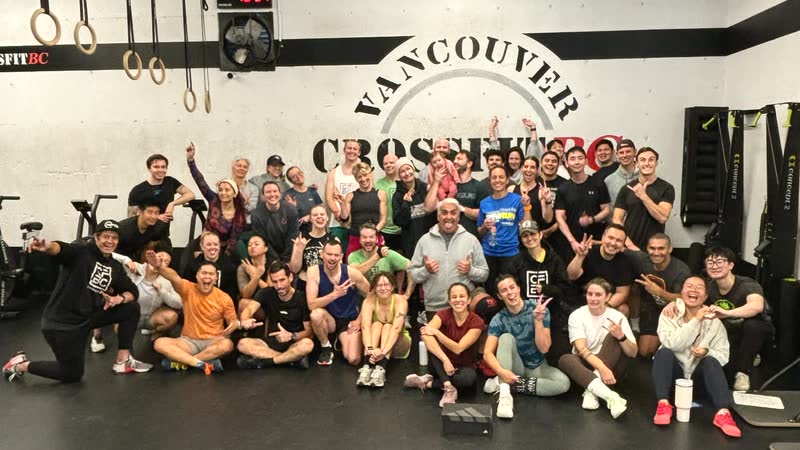
We have been operating in Vancouver since 2008. The members who have been here longest, some over 15 years, did not stay because the workouts were uniquely brilliant. Good programming is a baseline, not a moat. They stayed because the room became their third place. Their kids grew up in our lobby. Their weddings happened in our coaches' calendars. The people they trained next to in 2010 are the people they hike with in 2026.
We protect that on purpose. Coach tenure is high. Class times are sacred. The lobby has couches, not turnstiles. None of that is accidental.
If you want the broader case for why community beats discipline as a long-term strategy, see Why Community Beats Discipline. If you want to read what a fake community looks like, our piece on when a community is not really a community covers it bluntly.
How to choose a third-place gym
If you are choosing a gym in Vancouver, the workout is the lowest-stakes part of the decision. The room is the part that matters. Book a free intro at CFBC and we will give you a tour, introduce you to a coach, and let the room speak for itself. If it is a fit, we will be in your life for a long time. That is the entire promise.